
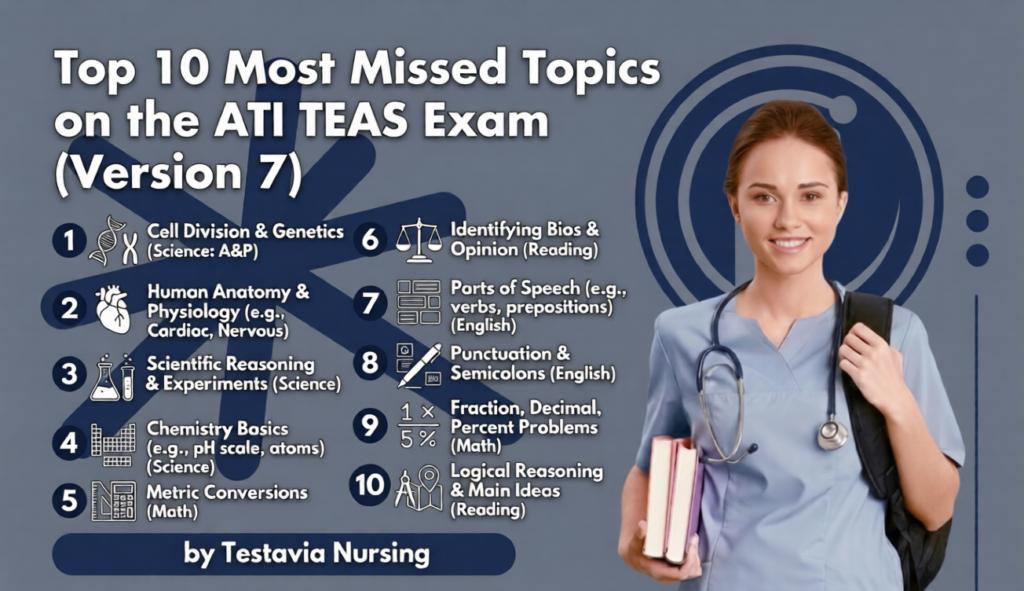
Thousands of students retake the TEAS every year. Same exam, same mistakes, same weak spots they never fixed the first time around. The difference between passing on your first attempt and sitting through that test again isn’t intelligence. It’s targeting the exact topics where most students fail.
ATI doesn’t publish which questions students miss most frequently. But patterns emerge. Official practice tests show consistent trouble spots. Student reports reveal the same struggles across thousands of test-takers. Score breakdowns highlight which topics tank composite scores.
Certain concepts show up repeatedly as major stumbling blocks. Anatomy pathways students can’t trace under pressure. Reading inference questions that confuse even strong readers. Math conversions that seem simple until the clock is ticking. Grammar rules that contradict how we actually speak.
Students who identify these high-difficulty topics early and drill them specifically instead of doing generic review score significantly higher. That’s the difference between wasting time on comfortable material and actually fixing your weak areas.
The science section alone covers 50 questions across anatomy, biology, chemistry, and scientific reasoning. Most students don’t know which specific topics within those categories cause the most trouble until they’ve already failed. Our breakdown of what’s actually tested on the TEAS 7 science section shows you which body systems and concepts appear most frequently. But this guide goes deeper—it shows you the ten specific topics students miss most across all four sections and exactly how to fix them before test day.
How We Identified the Most Missed Topics
This list comes from analyzing patterns across multiple sources:
- ATI’s official practice assessments and their difficulty ratings
- Student performance data from TEAS prep platforms
- Reported struggles from nursing student forums and social media groups
- Score breakdowns showing which sections consistently tank composite scores
The topics below aren’t necessarily the hardest conceptually. They’re the ones students underestimate, misunderstand or run out of time on.
Sometimes a topic is missed frequently because it requires multiple steps. Sometimes it’s because students never learned the underlying concept. Sometimes it’s just poor time management.
What matters: these ten topics cost students more points than any others. Master them and you dramatically improve your odds of passing on the first try.
Top 10 Most Missed TEAS Topics
1. Anatomy & Physiology Pathways (Science Section)
Why students miss it:
Tracing blood flow through the heart and lungs requires memorizing sequences—not just knowing individual structures. Students can identify the right atrium but can’t trace where blood goes next. Following digestive pathways or mapping nerve impulses creates the same problem.
You need to know the correct order. One wrong step in the sequence and you miss the question.
What the question looks like:
“Trace the pathway of blood from the right ventricle to the left atrium.”
“Where does oxygen-poor blood enter the heart?”
Why it’s hard:
Many students memorize heart chambers but never practice tracing the full pathway. They know the parts but can’t connect them in sequence.
Under time pressure, you forget one step and the entire answer falls apart.
How to fix it:
Draw the circulatory pathway on paper from memory. Start with oxygen-poor blood entering the right atrium → right ventricle → pulmonary artery → lungs → pulmonary veins → left atrium → left ventricle → aorta → body. Repeat until automatic.
Do the same for digestion:
- Mouth → esophagus → stomach → small intestine → large intestine → rectum
And the nervous system:
- Stimulus → sensory neuron → spinal cord → brain → motor neuron → muscle response
For comprehensive visual explanations of these anatomical pathways that students struggle to memorize, Innerbody’s interactive anatomy diagrams Innerbody’s interactive anatomy diagrams allow you to explore each body system with labeled structures and animated pathways. The site provides clear visuals of blood flow through the heart, digestive processes, and nervous system signal transmission exactly the sequences TEAS tests. Seeing these pathways traced visually in color-coded diagrams helps cement the order better than text descriptions alone.
Bottom line:
Pathways are memorization plus logic. Practice tracing them until you can do it without looking.
2. Inference Questions (Reading Section)
Why students miss it:
Inference questions ask what the passage implies but doesn’t directly state. Students choose answers based on what’s explicitly written. Or they bring in outside knowledge instead of drawing conclusions from context.
The passage never says “I believe healthcare reform is necessary.” But context clues point to that conclusion. That’s inference.
What the question looks like:
“Based on the passage, what can be inferred about the author’s perspective on healthcare reform?”
The answer isn’t stated. It’s suggested by tone, word choice, and supporting details.
Why it’s hard:
You’re reading between the lines. Students either overthink it (bringing in opinions not supported by the text) or underthink it (choosing what’s directly stated instead of what’s implied).
What’s directly stated isn’t inference. That’s recall.
How to fix it:
Practice identifying what the passage suggests versus what it states. Ask: “What does the author want me to believe based on how this is written?”
Eliminate answers that:
- Contradict the passage
- Require outside knowledge
- Restate what’s explicitly said (that’s not inference)
The correct answer is always supported by the passage, even if never directly stated.
Inference equals reading the subtext. The answer is in the passage you just have to read deeper than surface level.
3. Dosage Calculations and Ratios (Math Section)
Why students miss it:
Setting up the proportion incorrectly. Students know the formula but flip numerators and denominators or forget to convert units before solving.
Under time pressure, mistakes multiply.
What the question looks like:
“A medication is available in 250 mg tablets. The order is for 750 mg. How many tablets should be administered?”
Seems simple. But students set up 250/x = 750/1 instead of 250/1 = 750/x.
Why it’s hard:
You’re juggling multiple steps: identifying what you have, identifying what you need, setting up the proportion correctly, solving for x, and checking your units.
Miss one step and you get the wrong answer.
How to fix it:
Always set up proportions the same way. Use the format: what you have / 1 unit = what you need / x units.
Example: You have 250 mg per 1 tablet. You need 750 mg. How many tablets (x)?
250 mg / 1 tablet = 750 mg / x tablets
Cross multiply: 250x = 750
Solve: x = 3 tablets
Practice 10 dosage calculation problems daily using this exact setup. Build muscle memory so you don’t have to think about the format under pressure.
Bottom line:
Dosage calculations are high-yield and frequently missed. Consistent practice with the same setup method eliminates errors.
4. Subject-Verb Agreement with Indefinite Pronouns (English Section)
Why students miss it:
Words like “everyone,” “each,” “neither,” and “either” sound plural but are grammatically singular. Students trust their ear instead of the rule.
Conversational English ignores this constantly. We say “everyone brought their lunch” all the time. The TEAS doesn’t care, it tests formal grammar.
What the question looks like:
“Everyone (is/are) required to submit their form by Friday.”
Correct answer: “is” (everyone is singular)
But it sounds wrong because we’d say “their form” (plural possessive). That mismatch trips students up.
Why it’s hard:
What sounds right is often grammatically wrong. Your brain defaults to conversational patterns.
How to fix it:
Memorize the list of singular indefinite pronouns:
- each
- every
- everyone
- everybody
- anyone
- anybody
- someone
- somebody
- neither
- either
- nobody
- no one
All take singular verbs. Always.
“Each of the students has a textbook.”
“Everyone is ready.”
“Neither of the options is acceptable.”
Don’t trust what sounds right. Memorize the rule and apply it.
Bottom line:
Stop using your ear. Use the rule.
5. Mitosis vs. Meiosis (Science Section)
Why students miss it:
Students confuse which process produces which cells, how many chromosomes remain, and what the purpose is. Both processes involve cell division. The details blur together if you don’t have them clearly separated.
What the question looks like:
“Which type of cell division produces gametes?” (Answer: meiosis)
“How many daughter cells result from mitosis?” (Answer: two)
Why it’s hard:
The terms sound similar. The processes both split cells. Students who don’t drill the differences mix them up.
How to fix it:
Make a comparison chart and memorize it:
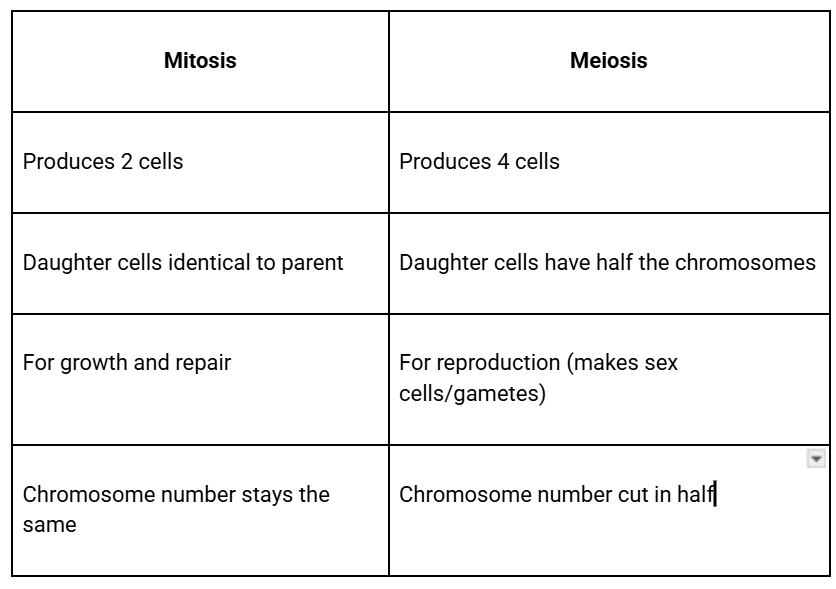
Drill this chart until you can reproduce it from memory. Write it out five times without looking.
Bottom line:
Know the differences cold. These questions show up on nearly every TEAS.
6. Metric Conversions (Math Section)
Why students miss it:
Forgetting which direction to move the decimal. Or mixing up conversion factors (is it multiply by 1,000 or divide by 1,000?).
Students know 1 kg = 1,000 g but forget whether to multiply or divide.
What the question looks like:
“Convert 2.5 kilograms to grams.”
Correct: 2.5 kg × 1,000 = 2,500 g
Wrong: 2.5 kg ÷ 1,000 = 0.0025 g (student moved decimal the wrong way)
Why it’s hard:
Under pressure, you second-guess. “Wait, am I going from smaller to bigger or bigger to smaller?”
How to fix it:
Use dimensional analysis every time. Set up the conversion so units cancel.
2.5 kg × (1,000 g / 1 kg) = 2,500 g (the kg cancels out, leaving grams)
Memorize key conversions:
- 1 kg = 1,000 g
- 1 g = 1,000 mg
- 1 L = 1,000 mL
- 1 m = 100 cm
Practice 10 conversion problems daily. Build automaticity.
Bottom line:
Metric conversions are easy points if you practice the method consistently.
7. DNA Structure and Base Pairing (Science Section)
Why students miss it:
Mixing up which bases pair with which (does A pair with T or G?). Or forgetting the structure of DNA (double helix, nucleotides, etc.).
Students memorize “DNA is a double helix” but don’t drill the base pairing rule.
What the question looks like:
“In a DNA molecule, adenine pairs with which base?” (Answer: thymine)
“What are the building blocks of DNA?” (Answer: nucleotides)
Why it’s hard:
There are four bases. Two pairing rules. Students mix them up.
How to fix it:
Memorize: A pairs with T. G pairs with C. (A-T, G-C)
DNA structure: double helix made of nucleotides. Each nucleotide has a sugar (deoxyribose), a phosphate group, and a nitrogenous base (A, T, G, or C).
Flashcard it:
Front: “What does adenine pair with?”
Back: “Thymine (A-T)”
Front: “What does guanine pair with?”
Back: “Cytosine (G-C)”
Bottom line:
DNA questions are straightforward if you know the pairing rule. Don’t skip this.
8. Main Idea vs. Supporting Detail (Reading Section)
Why students miss it:
Confusing a supporting detail for the main idea or choosing an answer that’s too broad or too narrow.
The main idea is what the entire passage is about, the central argument or purpose. Supporting details are the evidence or examples used to back it up. They’re related but not the same.
What the question looks like:
“What is the main idea of the passage?”
Students pick an answer that’s actually a supporting detail (too specific) or a vague summary that doesn’t capture the author’s primary point (too broad).
Why it’s hard:
Supporting details are interesting and specific. They stick in your memory. So students choose them instead of the bigger picture.
How to fix it:
Ask yourself: “If I had to summarize this passage in one sentence, what would I say?”
That’s the main idea. Supporting details are the how and why; the examples, statistics and explanations the author uses.
Practice identifying main ideas by reading a paragraph and summarizing it in 10 words or fewer. Then check: does your summary cover the whole paragraph or just part of it?
Bottom line:
Main idea equals the big picture. Supporting details equal the evidence. Know the difference.
9. Sentence Fragments (English Section)
Why students miss it:
A fragment looks like a sentence because it starts with a capital letter and ends with a period. But it’s missing a subject or a verb or it’s a dependent clause that can’t stand alone.
Your brain fills in the missing information when you read quickly. So it sounds fine.
What the question looks like:
“Identify the sentence fragment.”
Option: “Because the patient was stable.”
This is a fragment, it’s a dependent clause. What happened because the patient was stable?
Correct sentence: “Because the patient was stable, the doctor discharged him.”
Why it’s hard:
Fragments often sound fine when you skim. You have to slow down and check for completeness.
How to fix it:
Check for a subject and a verb. If the sentence has both and expresses a complete thought, it’s a sentence.
If it’s missing either or if it starts with a subordinating conjunction like “because,” “although,” “when,” “if” and doesn’t finish the thought—it’s a fragment.
Common fragment starters:
- Because
- Although
- When
- If
- While
- Since
These words create dependent clauses. They need an independent clause to complete the sentence.
Bottom line:
Fragments are incomplete thoughts. Make sure every sentence can stand alone.
10. Acid-Base pH Scale (Science Section)
Why students miss it:
Forgetting which numbers are acidic and which are basic. Or not knowing that pH 7 is neutral.
The scale is simple (0-14) but students confuse which end is which.
What the question looks like:
“A substance has a pH of 3. Is it acidic, basic, or neutral?” (Answer: acidic)
“Which pH indicates a strong base?” (Answer: pH 13-14)
Why it’s hard:
You’re memorizing a number scale. Under pressure, numbers blur.
How to fix it:
Memorize the scale:
- pH 0-6 = acidic (stomach acid ≈ pH 2)
- pH 7 = neutral (water)
- pH 8-14 = basic/alkaline (bleach ≈ pH 13)
Lower pH = more acidic. Higher pH = more basic.
Flashcard it:
Front: “Is pH 5 acidic or basic?”
Back: “Acidic (below 7)”
Front: “Is pH 10 acidic or basic?”
Back: “Basic (above 7)”
Bottom line:
pH scale questions are free points if you memorize the range. Don’t skip this.
Why These Topics Are Missed So Often
- They require memorization, not just understanding. You can’t logic your way through blood flow pathways or base pairing. You have to know them cold.
- They involve multi-step processes. Dosage calculations and metric conversions require setting up the problem correctly and solving it accurately. One misstep anywhere and you miss the question.
- They test formal rules that contradict casual speech. Subject-verb agreement with indefinite pronouns sounds wrong when you say it correctly. Students trust their ear instead of the rule.
- They’re easy to confuse with similar concepts. Mitosis vs. meiosis. Main idea vs. supporting detail. Acids vs. bases. Students mix them up under pressure.
- Time pressure makes students rush. Inference questions and sentence fragments require careful reading. Students skim, miss key details, and pick the wrong answer.
How to Study the Most Missed Topics
- Identify your weak areas first. Take a diagnostic test. Which of these ten topics did you miss? Those are your priorities.
- Drill one topic at a time. Don’t try to master all ten in one study session. Focus on one per day. Practice 10-15 questions on that topic. Review mistakes. Repeat.
- Use active recall, not passive review. Don’t just reread notes. Test yourself. Draw pathways from memory. Solve dosage problems without looking at the formula. Recite base pairing rules aloud.
- Practice under timed conditions. These topics are missed partly because students run out of time. Practice answering questions in 60-90 seconds. Build speed.
- Review mistakes immediately. When you miss a question, figure out why you missed it. Did you forget the rule? Set up the problem wrong? Misread the question? Fix the root cause, not just the symptom.
Understanding which specific topics cause the most trouble helps you prioritize study time. But it’s equally important to see how these weak areas fit into the bigger picture of TEAS preparation. For a complete breakdown of what makes the TEAS challenging and how to approach the exam strategically, our guide on whether the ATI TEAS is difficult explains what separates students who pass from those who struggle, including how much time to allocate to high-difficulty topics versus areas where you’re already strong.
What Testavia Does Differently
Most TEAS prep treats every topic equally. Testavia doesn’t. We identify exactly where you’re weak whether it’s A&P pathways, inference questions or dosage calculations and focus your practice on those trouble spots.
Our adaptive practice targets your weak areas with realistic questions that mirror actual TEAS difficulty. You’re not wasting time reviewing what you already know. You’re drilling the topics that will cost you points if you don’t fix them.
Final Thoughts
The TEAS isn’t designed to trick you. It’s designed to test whether you’ve mastered foundational skills needed for nursing school.
But certain topics consistently trip students up. Not because they’re impossible. Because they require precise knowledge, careful setup or formal grammar rules that contradict how we actually speak.
These ten topics cost students more points than any others. Master them and you eliminate the most common reasons students retake the exam. Focus on your weak areas. Practice deliberately. Test yourself under timed conditions and don’t trust what “sounds right” trust the rules.
You don’t need to be perfect on every question. But you do need to be solid on the topics that matter most.
These ten? They matter most.