
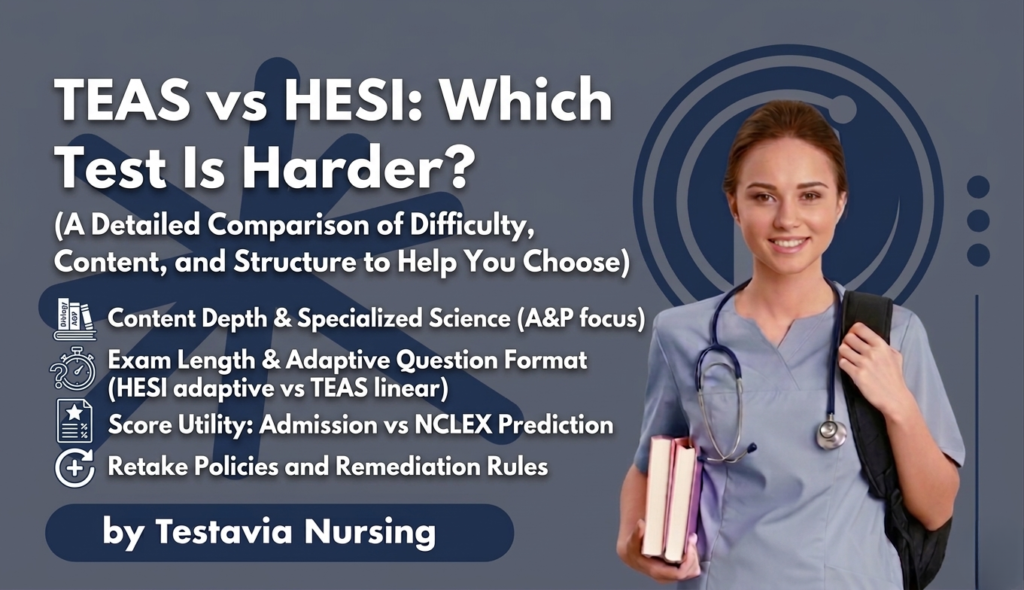
Which nursing entrance exam is harder—TEAS or HESI?
The answer depends on you. Your academic strengths. Your science background. How you handle test pressure.
Some students breeze through the TEAS and struggle with HESI. Others find HESI straightforward and freeze on TEAS questions. Neither exam is objectively “easier” they test different skills and reward different strengths.
Here’s what matters: most nursing programs require one or the other. You don’t get to choose based on which feels easier. However, understanding the differences helps you prepare strategically instead of wasting time on generic test prep that doesn’t match your exam’s specific format.
Students who target their weak areas and practice with exam-specific questions like those available through Testavia’s TEAS prep consistently score higher than peers who study broadly without understanding what each exam actually tests.
This guide breaks down TEAS vs HESI difficulty across every section. You’ll learn which exam tests what, where students struggle most, and how to prepare for whichever test your program requires.
Quick Comparison Overview
Before diving deep, here’s the snapshot:
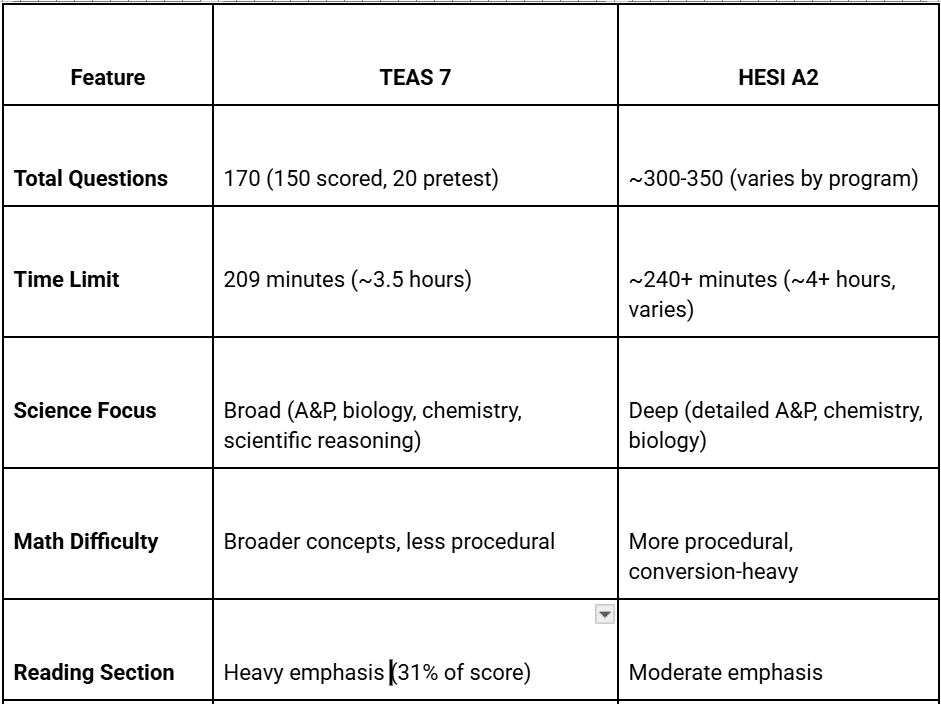
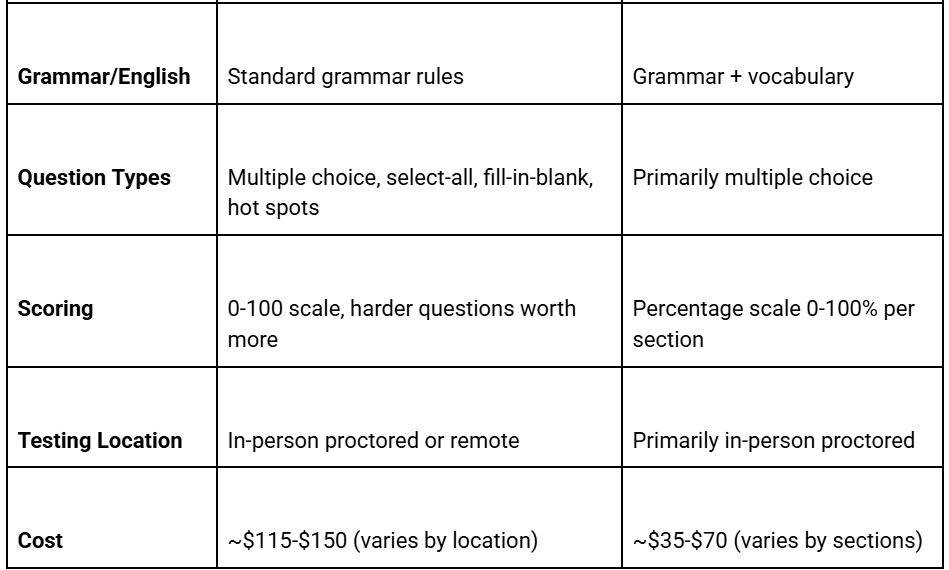
Neither exam is universally harder. TEAS tests breadth. HESI tests depth.
Content Breakdown: What Each Exam Actually Tests
TEAS 7 Content
The TEAS has four sections testing general academic skills:
Reading (31% of score): 39 questions in 55 minutes
Key concepts tested, paragraph and passage comprehension, craft and structure (author’s purpose, tone, text structure) and integration of knowledge (using multiple texts, evaluating arguments).
Reading is the heaviest weighted section. Strong readers have an advantage.
Math (22% of score): 34 questions in 57 minutes
Numbers and algebra (fractions, decimals, percentages, ratios, proportions, basic algebra). Measurement and data (metric conversions, perimeter, area, volume, statistics, interpreting graphs).
Calculator provided (four-function only).
Science (31% of score): 50 questions in 60 minutes
Human anatomy and physiology (10 body systems, 41% of science score). Biology (cell structure, genetics, DNA). Chemistry (atomic structure, reactions, acids/bases). Scientific reasoning (interpreting experiments and data).
Science is equally weighted with reading. However, A&P alone is 20 questions—nearly half the science section.
English & Language Usage (16% of score): 37 questions in 37 minutes
Conventions of standard English (punctuation, spelling, capitalization). Knowledge of language (grammar, sentence structure). Vocabulary (context clues, word parts).
Smallest section by weight but still critical. Missing several grammar questions can drop your composite score.
HESI A2 Content
HESI has more sections. Additionally, schools customize which sections they require.
Core sections (typically required):
Math: Basic arithmetic, fractions, decimals, percentages, ratios and proportions, metric conversions.
HESI math is procedural. Most questions follow standard setups. Practice makes it predictable.
Reading Comprehension: Passages followed by inference, main idea, and detail questions.
Similar to TEAS reading but less emphasized in overall scoring.
Vocabulary: Medical terminology and general academic vocabulary.
This section is HESI-specific. TEAS integrates vocabulary into reading and English sections.
Grammar: Sentence structure, punctuation, agreement, commonly confused words.
Standard grammar rules similar to TEAS English section.
Anatomy & Physiology: Detailed questions on body systems.
Considerably more in-depth than TEAS A&P. Expect specific questions about structures, functions, and processes.
Biology: Cell biology, cellular metabolism, genetics, DNA/RNA.
More detailed than TEAS biology. Requires deeper understanding of processes.
Chemistry: Atomic structure, chemical equations, periodic table, acids/bases, solutions.
More chemistry questions than TEAS. Additionally, more calculation-based.
Optional sections (some schools require):
Physics, learning style assessment, personality profile, critical thinking.
Section-by-Section Difficulty Comparison
Math: Procedural vs. Conceptual
TEAS Math:
Broader range of topics. Tests conceptual understanding of math principles. Word problems require setting up equations correctly.
Students report: “TEAS math felt less predictable. You had to think through each problem.”
HESI Math:
More focused on procedural calculations. Dosage calculations, metric conversions, ratio setups. Once you learn the formulas, problems follow patterns.
Students report: “HESI math was straightforward if you practiced the formulas.”
Which is harder?
TEAS math is harder if you struggle with applying concepts to new situations. HESI math is harder if you haven’t memorized conversion formulas.
Science: Breadth vs. Depth
TEAS Science:
Tests broad science knowledge. A&P, biology, chemistry, and scientific reasoning. You need general understanding across multiple areas.
Students report: “TEAS science covered everything. You can’t just focus on A&P.”
HESI Science:
Goes deeper into A&P specifically. Detailed questions about anatomical structures and physiological processes. Biology and chemistry questions are more specific.
Students report: “HESI A&P questions were detailed. You need to really know body systems.”
Which is harder?
TEAS science is harder if you don’t have recent biology or chemistry coursework. HESI science is harder if you haven’t taken anatomy and physiology recently or studied it thoroughly.
Reading: Heavy vs. Moderate Emphasis
TEAS Reading:
Thirty-one percent of your score. The largest section. Requires reading quickly and accurately under time pressure.
Students report: “Reading was exhausting. So many passages in 55 minutes.”
HESI Reading:
Present but not as heavily weighted. Passages are similar—comprehension, inference, main idea.
Students report: “HESI reading felt more manageable timewise.”
Which is harder?
TEAS reading is harder due to time pressure and weight. If reading is your weakness, TEAS punishes you more.
Grammar/English: Standard vs. Vocabulary-Heavy
TEAS English:
Tests standard grammar rules. Subject-verb agreement, punctuation, sentence structure. Vocabulary integrated into reading comprehension.
Students report: “TEAS grammar was straightforward if you know the rules.”
HESI Grammar:
Similar grammar rules plus a separate vocabulary section testing medical terminology.
Students report: “HESI vocabulary was challenging. Lots of medical terms I hadn’t seen.”
Which is harder?
HESI is harder if medical vocabulary is new to you. TEAS is harder if you struggle with formal grammar rules.
Time Pressure and Test Length
TEAS: 170 questions in 209 minutes
Roughly 74 seconds per question. Manageable pace if you don’t overthink.
HESI: 300-350 questions in 240+ minutes
Longer test. More endurance required. However, more time per question in most sections.
Which is harder?
TEAS requires faster decision-making. HESI requires stamina to stay focused for 4+ hours.
Students with attention issues may find HESI’s length more challenging. Students who second-guess themselves may struggle with TEAS’s tighter timing.
Student-Reported Difficulty
Based on verified student experiences from nursing forums and social media:
Students who found TEAS harder:
- “I scored 95% on HESI but only 89% on TEAS. TEAS felt less predictable.”
- “TEAS science covered too much. HESI focused on A&P which I knew well.”
- “TEAS reading comprehension killed me. Too much in too little time.”
Students who found HESI harder:
- “HESI A&P questions were so detailed. TEAS A&P was more surface-level.”
- “HESI vocabulary section threw me. I hadn’t studied medical terms.”
- “The length of HESI exhausted me. By hour 3 I was making careless errors.”
Students who found them similar:
- “If you know the content, both are passable. Preparation matters more than the exam.”
- “HESI felt longer but easier per question. TEAS felt shorter but harder per question. They balanced out.”
The common thread: students strong in their weakest subject on either exam find that exam easier.
Which Programs Require Which Exam?
TEAS is more common:
Most BSN programs and community college ADN programs require TEAS. It’s the more widely used entrance exam.
HESI is program-specific:
Some BSN programs require HESI, particularly those with strict science prerequisites. Accelerated programs sometimes prefer HESI because it tests deeper science knowledge.
Check your specific program requirements. Don’t assume. Some programs accept either. Others require a specific exam.
Understanding which nursing programs in your area don’t require either exam can help you explore all options. Our guide to nursing schools that don’t require TEAS in 2026 lists programs with alternative admission requirements. However, most competitive programs still use standardized entrance exams, so strong preparation for whichever test your program requires remains essential.
Pass Rates and Score Requirements
Neither exam has a universal “passing” score. Each nursing program sets its own minimum requirements.
Typical Competitive Scores
TEAS:
Programs typically want scores in the “Proficient” range (59-79%) or higher. Competitive programs often require 75%+ or “Advanced” range (80-90%+).
HESI:
Programs typically want 75-80% minimum. Some competitive programs require 85%+.
Section-Specific Requirements
Some programs require minimum scores in specific sections, not just overall.
Example: “70% composite score with no section below 65%.”
This means you can’t compensate for a weak science score with a strong reading score.
Retake Policies
TEAS:
Generally allows retakes after 14 days. Some programs limit total attempts (typically 3 tries maximum).
HESI:
Retake policies vary by testing site and program. Check with your specific nursing school.
Both exams charge full price for retakes.
How to Prepare for Your Specific Exam
If Taking TEAS
Focus on:
- Reading comprehension and speed
- Broad science review (A&P, biology, chemistry)
- Word problems and conceptual math
- Standard grammar rules
Study timeline: 6-8 weeks recommended
Practice strategy: Take full-length timed practice tests. TEAS rewards speed and breadth.
If Taking HESI
Focus on:
- Detailed A&P (memorize structures and functions)
- Medical vocabulary
- Procedural math (memorize formulas)
- Grammar rules
Study timeline: 6-8 weeks recommended
Practice strategy: Deep dive into A&P. Drill vocabulary flashcards. Practice procedural math setups.
If You’re Taking Both
Some students apply to multiple programs requiring different exams.
Study efficiently: Focus on overlapping content first (A&P, basic math, grammar). Then target exam-specific differences (HESI vocabulary, TEAS reading comprehension).
Schedule strategically: Take the exam for your top-choice program first when you’re freshest.
Since both TEAS and HESI test anatomy and physiology heavily just at different depths mastering A&P content benefits you regardless of which exam you take. Our comprehensive TEAS science section breakdown covers the 10 body systems tested on TEAS, which also form the foundation of HESI’s more detailed A&P questions. Starting with broad A&P knowledge and then deepening it for HESI is more efficient than studying each exam’s content separately.
Common Mistakes to Avoid
Mistake #1: Assuming One is “Easier”
Neither exam is universally easier. Your strengths determine difficulty.
Fix: Take a diagnostic practice test for both exams. See which one aligns better with your current knowledge.
Mistake #2: Studying Generic Content
Generic “nursing entrance exam” prep doesn’t target specific question formats.
Fix: Use exam-specific study materials. ATI materials for TEAS. Elsevier materials for HESI.
Mistake #3: Ignoring Weak Sections
Students often over-study their strong subjects and avoid weak ones.
Fix: Allocate more study time to your lowest practice test scores.
Mistake #4: Not Practicing Under Timed Conditions
Knowing content isn’t enough. You need to perform under time pressure.
Fix: Take at least 2-3 full-length timed practice tests before exam day.
Mistake #5: Cramming Last Minute
Both exams test cumulative knowledge. Cramming doesn’t work.
Fix: Start studying 6-8 weeks before your exam date.
According to research from the National League for Nursing, students who space their test preparation over 6-8 weeks with consistent daily study outperform those who cram intensively in the final two weeks. The spacing effect distributing practice over time improves long-term retention and test performance more effectively than massed practice. This principle applies equally to TEAS and HESI preparation.
The Real Answer: Which Is Harder?
TEAS is harder if you:
- Struggle with reading comprehension
- Prefer deep focus on fewer topics
- Dislike time pressure
- Have weak general science knowledge
HESI is harder if you:
- Haven’t taken A&P recently or thoroughly
- Struggle with medical vocabulary
- Have difficulty with long tests (stamina issues)
- Prefer conceptual math over procedural math
Both are manageable if you:
- Identify your weak areas early
- Study strategically for 6-8 weeks
- Take practice tests under timed conditions
- Focus on exam-specific content
The difficulty isn’t in the exam itself. It’s in the mismatch between what the exam tests and what you’re currently strong in.
Understanding what comes after these entrance exams the actual intensity of nursing school provides important context for why programs use challenging admissions tests. Our detailed guide on what nursing school is actually like explains the academic rigor, clinical demands, and time commitment ahead. Entrance exams aren’t meant to be easy they’re screening tools to identify students capable of handling nursing school’s demands.
Final Thoughts
TEAS vs HESI difficulty isn’t black and white. Your academic background, learning style, and test-taking skills all influence which exam feels harder.
TEAS tests breadth. You need solid general knowledge across reading, math, science, and English. Strong readers have an advantage. Time management is critical.
HESI tests depth. You need detailed A&P knowledge, medical vocabulary, and procedural math skills. Strong science students have an advantage. Stamina matters.
Don’t waste energy debating which is “easier.” Focus on preparing for the exam your program requires.
Take a diagnostic test. Identify weak areas. Study strategically. Practice under timed conditions. Show up prepared.
Both exams are passable with proper preparation. Neither is a barrier if you invest the time to study smart.
The right prep makes all the difference.