
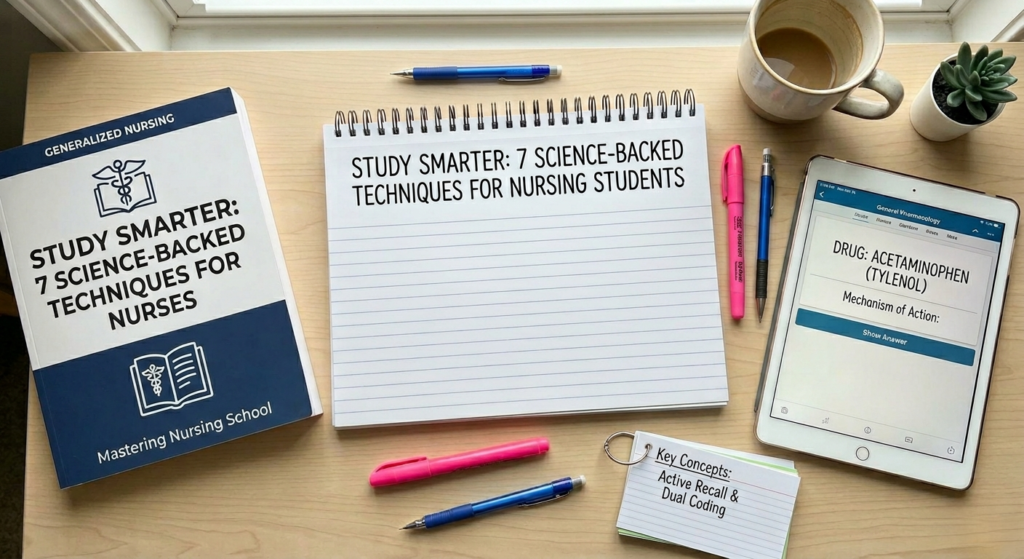
You’re spending 25 hours a week studying for nursing school. You’re rereading chapters. Highlighting everything. Making color-coded notes. Cramming the night before exams.
And you’re still getting Bs and Cs.
Here’s the hard truth: studying more hours doesn’t equal better grades. In fact, research from cognitive psychology shows that most students rely on study methods that don’t work highlighting, rereading and marathon study sessions while ignoring techniques proven to double retention and cut study time in half.
If you want to know how to study less and get better grades, the answer isn’t working harder. It’s working smarter. Specifically, it’s using evidence-based learning strategies that align with how your brain actually processes and retains information.
Students at Testavia who master these techniques consistently report studying 40-50% fewer hours while improving their test scores by 15-20 points. Understanding how to study less and get better grades transforms nursing school from overwhelming to manageable. They’re not more intelligent. They’re more strategic.
This guide breaks down 7 science-backed study techniques proven by decades of research in cognitive psychology and neuroscience. These are specific, actionable strategies used by top-performing nursing students worldwide.
Why Most Students Study Wrong (And What Actually Works)
Before we dive into the techniques, let’s talk about what doesn’t work.
According to a landmark 2013 study by cognitive psychologists at Kent State University and Washington University, researchers evaluated 10 common study techniques. Only two received “high utility” ratings. Five including the ones most students use daily received “low utility” ratings.
Low-Utility Techniques (Don’t Work):
- ❌ Highlighting and underlining: Makes you feel productive but doesn’t improve retention
- ❌ Rereading notes or textbooks: Creates false familiarity, not real learning
- ❌ Summarizing: Time-consuming with limited benefits
- ❌ Cramming (massed practice): Information disappears within days
- ❌ Reviewing in the same order every time: Doesn’t prepare you for varied test questions
Students using these methods study for hours and retain maybe 30-40% of the material.
High-Utility Techniques (Actually Work):
- ✅ Practice testing (active recall)
- ✅ Spaced repetition (distributed practice)
Students using these methods study less and retain 70-80%+ of material long-term.
The difference? Active engagement vs. passive review. Your brain learns through retrieval, not recognition.
How to Study Less and Get Better Grades: The 7 Science-Backed Techniques
1. Active Recall: Test Yourself Before the Test
What It Is: Actively retrieving information from memory without looking at notes.
The Science: Research by Roediger and Karpicke (2006) found that students who tested themselves retained 50% more information after one week compared to students who simply reread material.
Why? Every time you force your brain to retrieve information, you strengthen the neural pathways to that memory. Rereading creates weak, temporary connections. Testing creates strong, permanent ones.
How to Apply It for Nursing School:
Instead of rereading your pharmacology notes:
- First, close your notes
- Then, write down everything you remember about ACE inhibitors: mechanism of action, side effects, patient teaching, contraindications
- Next, check your notes only after attempting recall
- Finally, identify gaps and quiz yourself again
Instead of rereading anatomy chapters:
- Initially, look at a blank body diagram
- Subsequently, label structures from memory
- Afterward, check accuracy and test again
Tools That Work:
- Quizlet (flashcards with self-testing mode)
- Anki (spaced repetition flashcard app)
- Blank diagrams for anatomy practice
- Practice NCLEX questions
Common Mistake: Looking at the answer too soon. Struggle for 10-15 seconds before checking. That struggle is learning.
2. Spaced Repetition: Study Over Time, Not All at Once
What It Is: Reviewing material at increasing intervals (1 day, 3 days, 7 days, 14 days) instead of cramming everything into one session.
The Science: Over 100 years of research confirms the “spacing effect.” A 2006 meta-analysis of 317 experiments found that spaced practice produces dramatically better long-term retention than massed practice (cramming).
Your brain consolidates information during sleep and rest periods. Therefore, when you cram, you overload working memory. Conversely, when you space your study sessions, you give your brain time to strengthen connections between concepts.
How to Apply It for Nursing School:
Week 1 Study Schedule (Pathophysiology Exam in 4 Weeks):
- Day 1: Learn respiratory disorders (2 hours)
- Day 3: Review respiratory disorders (30 minutes) + learn cardiovascular disorders (2 hours)
- Day 7: Review both topics (45 minutes) + learn renal disorders (2 hours)
- Day 14: Review all three topics (1 hour) + learn new material
Compare this to cramming all topics in Week 4: you’ll retain 2-3x more information with less total study time.
Digital Tools:
- Anki (automatically spaces flashcard reviews)
- RemNote (spaced repetition note-taking app)
- Google Calendar (schedule review sessions in advance)
Rule of Thumb: Review new material within 24 hours, then at 3 days, 7 days and 14 days.
3. Interleaving: Mix Topics Instead of Blocking Them
What It Is: Studying multiple related topics in one session instead of mastering one topic before moving to the next.
The Science: Research shows interleaving improves problem-solving and transfer of knowledge. Specifically, students learn to distinguish between similar concepts and apply knowledge flexibly.
For example, studying diabetes → hypertension → COPD → diabetes → hypertension → COPD works better than diabetes (2 hours) → hypertension (2 hours) → COPD (2 hours). Furthermore, this mixed approach forces your brain to actively differentiate rather than passively recognize patterns.
How to Apply It for Nursing School:
Instead of:
- Monday: All cardiac medications
- Tuesday: All respiratory medications
- Wednesday: All diabetes medications
Do This:
- Monday: Beta blockers → bronchodilators → insulin → ACE inhibitors → corticosteroids → metformin
- Review across categories, forcing your brain to differentiate
This is especially powerful for pharmacology and pathophysiology where you need to compare and contrast similar drugs or disease processes.
4. Elaborative Interrogation: Ask “Why?” and “How?”
What It Is: Constantly asking yourself why facts are true and how concepts connect.
The Science: When you generate explanations, you create richer, more connected memories. Research shows this technique improves understanding and retention, especially for complex material.
How to Apply It for Nursing School:
Don’t just memorize: “Loop diuretics cause hypokalemia.”
Ask why: “Why do loop diuretics cause hypokalemia?”
- Answer: They block sodium and chloride reabsorption in the loop of Henle, which also increases potassium excretion
Then ask how: “How does this affect patient care?”
- Answer: Monitor potassium levels, watch for muscle weakness, supplement if needed
Consequently, this transforms rote memorization into deep understanding.
Practice Questions:
- “Why does left-sided heart failure cause pulmonary edema?”
- “How does morphine help with acute pulmonary edema beyond pain relief?”
- “Why do we give aspirin for MI instead of other pain relievers?”
5. Dual Coding: Combine Words with Visuals
What It Is: Pairing verbal information with visual representations (diagrams, charts, concept maps).
The Science: Paivio’s Dual Coding Theory (1990) shows that information encoded both verbally and visually is easier to retrieve because you have two pathways to the same memory.
How to Apply It for Nursing School:
For pathophysiology:
- Draw the pathway: atherosclerosis → plaque buildup → reduced blood flow → angina → MI
- Add visuals: sketch narrowed arteries, blocked vessels, damaged heart tissue
For medications:
- Create a visual flowchart: drug enters body → mechanism of action → therapeutic effects → side effects → nursing considerations
For lab values:
- Make a chart with normal ranges, what high/low means, causes, symptoms, interventions
Tools:
- Draw diagrams by hand (better retention than typing)
- Use concept mapping software (XMind, MindMeister)
- Create visual mnemonics
6. Self-Explanation: Teach the Material to Yourself
What It Is: Explaining concepts in your own words as if teaching someone else.
The Science: The “Feynman Technique” and self-explanation research show that teaching forces you to organize knowledge, identify gaps, and create deeper understanding.
How to Apply It for Nursing School:
Step 1: Choose a concept (e.g., left vs. right-sided heart failure)
Step 2: Explain it aloud without looking at notes, as if teaching a classmate:
- “Left-sided heart failure means the left ventricle can’t pump effectively, so blood backs up into the lungs, causing pulmonary congestion. Symptoms include dyspnea, crackles, and pink frothy sputum. Right-sided heart failure means blood backs up into systemic circulation, causing peripheral edema, JVD, and hepatomegaly…”
Step 3: When you get stuck, that’s a gap in knowledge. Therefore, go back to notes, fill the gap, and try again.
Step 4: Repeat until you can explain fluently without hesitation.
Ultimately, this technique is especially powerful for clinical concepts, disease processes and nursing interventions.
7. Practice Testing Under Exam Conditions
What It Is: Taking full-length practice exams under timed, test-like conditions.
The Science: Testing yourself prepares you not just for the content but for the experience of taking the exam. It reduces test anxiety and improves time management.
Moreover, research shows that students using practice testing scored 50% higher on final exams than students who only reviewed notes.
How to Apply It for Nursing School:
2 weeks before exam:
- Take a full-length practice test (same number of questions, same time limit)
- Simulate test conditions: quiet room, no phone, timed
- Score yourself and identify weak areas
1 week before exam:
- Take another practice test
- Note improvement
- Focus remaining study time on persistent weak areas
For NCLEX/TEAS prep:
- Use official practice tests (ATI, Kaplan, UWorld)
- Mimic test-day conditions
- Track scores over time
Understanding what makes nursing school exams difficult helps you prepare strategically. Our guide on whether nursing school is as hard as people say covers exam formats, time pressures, and what to expect so you can tailor your study approach accordingly.
What NOT to Do: Study Habits That Waste Your Time
Even with good techniques, bad habits can sabotage your progress:
❌ Studying with distractions (TV, social media, notifications)
- Your brain can’t multitask. Every distraction resets focus.
❌ Passive highlighting without testing
- Makes notes pretty. Doesn’t improve memory.
❌ Studying the same way for every subject
- Pharmacology needs flashcards. Pathophysiology needs concept maps. Clinical skills need practice.
❌ Studying when exhausted
- Sleep-deprived studying is 50% less effective. Sleep before cramming.
❌ Avoiding practice questions because they’re “too hard”
- Struggle = learning. Comfort = false confidence.
How to Study Less and Get Better Grades: The Complete Strategy
Combining all 7 techniques creates a study system that maximizes retention while minimizing wasted time.
Sample Study Session (2 Hours for Pharmacology):
Hour 1: Active Learning
- 30 min: Read new chapter on cardiac medications (first exposure)
- 15 min: Create visual chart comparing drug classes
- 15 min: Self-explain mechanisms of action aloud
Hour 2: Active Recall + Spaced Review
- 20 min: Test yourself on today’s content (flashcards, blank diagrams)
- 20 min: Review material from 3 days ago (spaced repetition)
- 20 min: Mixed practice questions interleaving today’s and previous topics
Total: 2 hours of focused, active learning beats 4 hours of passive rereading.
Study Schedules That Actually Work
Daily Study Routine (Nursing Student):
- Morning (30 min): Review yesterday’s material (spaced repetition)
- After class (1 hour): Active learning on new material (dual coding, self-explanation)
- Evening (45 min): Practice questions + review material from last week
Weekly Review (90 min on Sunday):
- Full practice test covering all material from the week
- Identify weak areas
- Adjust next week’s focus
Exam Prep (2-3 Weeks Out):
- Stop learning new material 1 week before exam
- Focus entirely on spaced review and practice testing
- Take 2-3 full-length practice exams
Tools and Resources
Flashcard Apps (Active Recall + Spaced Repetition):
- Anki (free, best for serious students)
- Quizlet (user-friendly, huge nursing database)
- RemNote (combines notes + flashcards)
Practice Question Banks:
- Testavia TEAS/Nursing prep
- UWorld (NCLEX questions)
- ATI (nursing school exams)
- Kaplan (NCLEX prep)
Time Management:
- Pomodoro timer (25 min focused work + 5 min break)
- Forest app (prevents phone distractions)
- Google Calendar (schedule spaced reviews in advance)
Visual Learning:
- RegisteredNurseRN (YouTube – nursing concepts explained visually)
- Osmosis (medical videos with illustrations)
- Hand-drawn concept maps (better retention than typing)
Conclusion
The difference between struggling nursing students and top performers is strategy.
You don’t need to study more. You need to study differently. Specifically, you need to replace passive techniques (rereading, highlighting) with active techniques (testing, spacing, interleaving).
Research is clear: students using evidence-based study techniques spend less time studying and perform significantly better on exams. They retain information longer. They understand concepts deeper. They score higher on NCLEX.
Therefore, stop rereading your notes for the fifth time. Start testing yourself. Stop cramming the night before. Start spacing your reviews. Stop studying one topic for hours. Start interleaving.
The techniques in this guide are backed by decades of research in cognitive psychology and neuroscience. They work for medical students, for law students and for nursing students.
They’ll work for you.
Start today. Pick one technique. Try it for a week and track your results.
Your grades and your free time will thank you.