Anatomy and physiology makes or breaks your TEAS science score.
Out of 50 total science questions, 18 are devoted to human anatomy and physiology that’s 41% of the entire science section. More than biology. More than chemistry. More than scientific reasoning.
If you don’t know the cardiovascular system from the respiratory system, you’re giving away 36% of your science points before you even start.
Here’s the problem: most students try to memorize everything. Every bone. Every muscle. Every enzyme. That’s impossible in 4-6 weeks, especially when preparing for TEAS 7 anatomy and physiology.
The TEAS doesn’t test medical school-level details. It tests whether you understand how body systems work, which structures belong to which systems and how systems interact.
Strategic preparation with resources like Testavia’s TEAS 7 Science guides means focusing on high-yield structures and functions the concepts that appear on every test version rather than obscure anatomical details that rarely show up.
This guide breaks down exactly what TEAS 7 tests, which body systems matter most, high-yield facts for each system and a 4-week study plan that actually works.
What Anatomy and Physiology Topics Does TEAS 7 Actually Test?
According to the official ATI TEAS 7 content outline, you’ll see questions on:
11 Body Systems:
- Cardiovascular system
- Respiratory system
- Digestive system
- Nervous system
- Muscular system
- Reproductive system (male and female)
- Integumentary system (skin)
- Endocrine system
- Urinary system
- Immune/Lymphatic system
- Skeletal system
Additional Concepts:
- Body organization (cells → tissues → organs → systems)
- Anatomical terminology (planes, cavities, directional terms)
- How systems interact and support each other
The TEAS focuses on structure AND function. You need to know what organs are in each system AND what they do.
TEAS 7 Anatomy and Physiology: The 10 Body Systems Breakdown
1. Cardiovascular System
Primary Function: Transport oxygen, nutrients, hormones and waste products throughout the body
Key Structures:
- Heart: Four chambers (right atrium, right ventricle, left atrium, left ventricle)
- Blood vessels: Arteries (carry blood away from heart), veins (carry blood toward heart), capillaries (exchange site)
- Blood: Red blood cells (carry oxygen), white blood cells (immune function), platelets (clotting), plasma (liquid portion)
High-Yield Facts:
- Pulmonary circulation: right side of heart → lungs → left side of heart
- Systemic circulation: left side of heart → body → right side of heart
- Importantly, arteries carry oxygenated blood (except pulmonary artery)
- Conversely, veins carry deoxygenated blood (except pulmonary vein)
- Finally, valves prevent backflow of blood
Common TEAS Question Types:
- “Which chamber pumps oxygenated blood to the body?” (Left ventricle)
- “What is the function of capillaries?” (Exchange gases/nutrients)
- “Which blood cells are responsible for immunity?” (White blood cells)
2. Respiratory System
Primary Function: Exchange gases (oxygen in, carbon dioxide out)
Key Structures:
- Upper respiratory: Nose, pharynx, larynx
- Lower respiratory: Trachea, bronchi, bronchioles, alveoli
- Supporting structures: Diaphragm, intercostal muscles, lungs
High-Yield Facts:
- Gas exchange occurs in alveoli (tiny air sacs)
- During inhalation, diaphragm contracts → lungs expand → air flows in
- During exhalation, diaphragm relaxes → lungs compress → air flows out
- Therefore, oxygen diffuses from alveoli into blood
- Meanwhile, carbon dioxide diffuses from blood into alveoli
Common TEAS Question Types:
- “Where does gas exchange occur?” (Alveoli)
- “What muscle controls breathing?” (Diaphragm)
- “Which gas is expelled during exhalation?” (Carbon dioxide)
3. Digestive System
Primary Function: Break down food into nutrients the body can absorb
Key Structures:
- Alimentary canal: Mouth → esophagus → stomach → small intestine → large intestine → rectum → anus
- Accessory organs: Liver, gallbladder, pancreas, salivary glands
High-Yield Facts:
- Mouth: Mechanical digestion (chewing) + chemical digestion (saliva/amylase)
- Stomach: Churns food + secretes acid and pepsin (protein digestion)
- Small intestine: Most nutrient absorption occurs here (villi and microvilli increase surface area)
- Pancreas: Secretes digestive enzymes and bicarbonate
- Liver: Produces bile (breaks down fats)
- Large intestine: Absorbs water, forms feces
Common TEAS Question Types:
- “Where does most nutrient absorption occur?” (Small intestine)
- “What organ produces bile?” (Liver)
- “What is the function of villi?” (Increase absorption surface area)
4. Nervous System
Primary Function: Control and coordinate body functions through electrical and chemical signals
Key Structures:
- Central Nervous System (CNS): Brain and spinal cord
- Peripheral Nervous System (PNS): All nerves outside CNS
- Brain divisions: Cerebrum (thinking), cerebellum (coordination), brainstem (automatic functions)
- Neurons: Basic functional unit of nervous system
High-Yield Facts:
- Somatic nervous system: Voluntary control (skeletal muscles)
- Autonomic nervous system: Involuntary control (heart rate, digestion)
- Sympathetic: “Fight or flight” (increases heart rate, dilates pupils)
- Parasympathetic: “Rest and digest” (decreases heart rate, stimulates digestion)
- Reflex arc: Stimulus → sensory neuron → spinal cord → motor neuron → response (bypasses brain for speed)
Common TEAS Question Types:
- “Which part of the brain controls balance?” (Cerebellum)
- “What does the autonomic nervous system control?” (Involuntary functions)
- “Which division activates ‘fight or flight’?” (Sympathetic)
5. Endocrine System
Primary Function: Produce and secrete hormones that regulate body functions
Key Structures and Hormones:
- Pituitary gland: “Master gland” (controls other glands)
- Thyroid: Metabolism regulation (thyroxine)
- Pancreas: Blood sugar regulation (insulin lowers glucose, glucagon raises glucose)
- Adrenal glands: Stress response (adrenaline/epinephrine, cortisol)
- Ovaries/Testes: Sex hormones (estrogen, progesterone, testosterone)
High-Yield Facts:
- Hormones travel through bloodstream (slower than nervous system)
- Negative feedback loops maintain homeostasis
- Insulin: Lowers blood glucose (helps cells absorb sugar)
- Glucagon: Raises blood glucose (releases stored sugar)
Common TEAS Question Types:
- “Which hormone lowers blood sugar?” (Insulin)
- “What gland regulates metabolism?” (Thyroid)
- “What is the body’s stress hormone?” (Cortisol/adrenaline)
6. Immune/Lymphatic System
Primary Function: Defend against pathogens and maintain fluid balance
Key Structures:
- Lymphatic vessels: Transport lymph fluid
- Lymph nodes: Filter pathogens
- Spleen: Filters blood, stores white blood cells
- Thymus: Matures T-cells
- White blood cells: Various types fight infection
High-Yield Facts:
- Innate immunity: Non-specific defenses (skin, inflammation, phagocytes)
- Adaptive immunity: Specific defenses (antibodies, memory cells)
- Active immunity: Body produces own antibodies (vaccination, previous infection)
- Passive immunity: Receive antibodies from external source (mother to baby, antiserum)
Common TEAS Question Types:
- “What is the difference between innate and adaptive immunity?”
- “Which immunity type provides long-term protection?” (Active/adaptive)
- “What cells produce antibodies?” (B-cells/lymphocytes)
7. Skeletal System
Primary Function: Support, protection, movement, mineral storage, blood cell production
Key Structures:
- 206 bones in adult human body
- Axial skeleton: Skull, vertebral column, ribcage
- Appendicular skeleton: Limbs and girdles
- Bone types: Long (femur), short (carpals), flat (skull), irregular (vertebrae)
High-Yield Facts:
- Red bone marrow: Produces blood cells (hematopoiesis)
- Yellow bone marrow: Stores fat
- Compact bone: Dense outer layer
- Spongy bone: Inner layer with spaces
- Bones store calcium and phosphorus
- Joints: Where two bones meet (allow movement)
Common TEAS Question Types:
- “Where are blood cells produced?” (Red bone marrow)
- “What minerals do bones store?” (Calcium)
- “What type of bone is the femur?” (Long bone)
8. Muscular System
Primary Function: Movement, heat production, posture maintenance
Key Muscle Types:
- Skeletal muscle: Voluntary, striated, attached to bones
- Cardiac muscle: Involuntary, striated, found only in heart
- Smooth muscle: Involuntary, non-striated, found in organs/blood vessels
High-Yield Facts:
- Muscles work in pairs: agonist (prime mover) and antagonist (opposes movement)
- Example: Biceps flexes arm (agonist), triceps extends arm (antagonist)
- Tendons: Connect muscle to bone
- Ligaments: Connect bone to bone
- Muscles need ATP (energy) to contract
Common TEAS Question Types:
- “Which muscle type is voluntary?” (Skeletal)
- “What connects muscle to bone?” (Tendons)
- “Which muscle type is found in the digestive tract?” (Smooth)
9. Reproductive System
Primary Function: Produce offspring
Male Reproductive System:
- Testes: Produce sperm and testosterone
- Epididymis: Stores and matures sperm
- Vas deferens: Transports sperm
- Prostate/seminal vesicles: Produce seminal fluid
Female Reproductive System:
- Ovaries: Produce eggs (ova) and hormones (estrogen, progesterone)
- Fallopian tubes: Site of fertilization
- Uterus: Supports fetal development
- Cervix: Opening to uterus
- Vagina: Birth canal
High-Yield Facts:
- Menstrual cycle: Approximately 28 days
- Ovulation: Egg released around day 14
- Fertilization: Usually occurs in fallopian tube
- Implantation: Fertilized egg attaches to uterine wall
Common TEAS Question Types:
- “Where does fertilization typically occur?” (Fallopian tube)
- “Which organ produces testosterone?” (Testes)
- “What hormone prepares the uterus for pregnancy?” (Progesterone)
10. Urinary/Renal System
Primary Function: Filter blood, remove waste, regulate fluid/electrolyte balance
Key Structures:
- Kidneys: Filter blood, produce urine
- Ureters: Transport urine from kidneys to bladder
- Bladder: Stores urine
- Urethra: Expels urine from body
High-Yield Facts:
- Nephron: Functional unit of kidney (filtration occurs here)
- Kidneys regulate blood pressure and pH
- Kidneys activate vitamin D
- Kidneys produce erythropoietin (stimulates red blood cell production)
- Urine composition: water, urea, salts, other waste products
Common TEAS Question Types:
- “What is the functional unit of the kidney?” (Nephron)
- “Which organ stores urine?” (Bladder)
- “What waste product is filtered by kidneys?” (Urea)
How Body Systems Work Together
The TEAS often tests system interactions. Therefore, understanding these connections will help you score higher, especially when questions ask you to analyze real-world scenarios. For detailed strategies on approaching these integrated questions, check out our comprehensive TEAS 7 science section study guide.
Common System Interactions:
Cardiovascular + Respiratory:
- First, respiratory system oxygenates blood
- Then, cardiovascular system delivers oxygenated blood to tissues
Digestive + Cardiovascular:
- Initially, digestive system absorbs nutrients
- Subsequently, cardiovascular system transports nutrients to cells
Nervous + Muscular:
- First, nervous system sends signals to muscles
- As a result, muscles contract in response to nerve impulses
Endocrine + Reproductive:
- Hormones regulate reproductive cycles
- Simultaneously, reproductive organs produce sex hormones
Skeletal + Muscular:
- Muscles pull on bones to create movement
- Meanwhile, bones provide attachment points for muscles
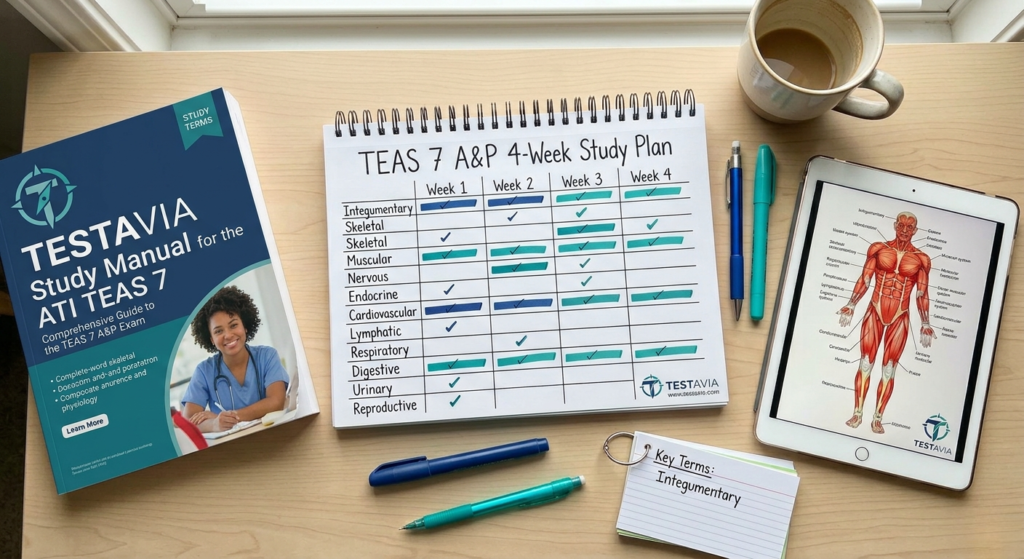
4-Week TEAS A&P Study Plan
This plan assumes you’re studying 60-90 minutes per day, 5-6 days per week.
Week 1: Foundation Systems
Day 1-2: Cardiovascular System
- Learn heart anatomy (4 chambers, valves)
- Understand blood flow pathway
- Study blood components and functions
- Practice 10-15 cardiovascular questions
Day 3-4: Respiratory System
- Learn respiratory structures
- Understand gas exchange process
- Study breathing mechanics
- Practice 10-15 respiratory questions
Day 5-6: Digestive System
- Learn digestive tract pathway
- Study accessory organs (liver, pancreas)
- Understand absorption process
- Practice 10-15 digestive questions
Day 7: Review Week 1
- Create summary notes for all 3 systems
- Take mixed practice quiz (30 questions)
- Additionally, identify weak areas for focused review
Week 2: Control and Communication Systems
Day 1-2: Nervous System
- Learn CNS vs PNS
- Study brain divisions
- Understand autonomic nervous system (sympathetic vs parasympathetic)
- Practice 10-15 nervous system questions
Day 3-4: Endocrine System
- Learn major glands and hormones
- Understand hormone functions
- Study feedback loops
- Practice 10-15 endocrine questions
Day 5-6: Immune/Lymphatic System
- Study immune structures
- Understand innate vs adaptive immunity
- Learn active vs passive immunity
- Practice 10-15 immune questions
Day 7: Review Week 2
- Create summary notes
- Take mixed practice quiz (30 questions)
- Review Week 1 concepts briefly
Week 3: Support and Movement Systems
Day 1-2: Skeletal System
- Learn bone types and functions
- Study major bones (skull, femur, vertebrae, ribs)
- Understand bone marrow function
- Practice 10-15 skeletal questions
Day 2-3: Muscular System
- Study 3 muscle types
- Understand muscle contraction
- Learn tendons vs ligaments
- Practice 10-15 muscular questions
Day 4-5: Reproductive System
- Learn male and female structures
- Understand reproductive hormones
- Study menstrual cycle and fertilization
- Practice 10-15 reproductive questions
Day 6: Urinary/Renal System
- Study kidney structures and functions
- Learn urine formation process
- Understand waste removal
- Practice 10-15 urinary questions
Day 7: Review Week 3
- Create summary notes
- Take mixed practice quiz (40 questions)
- Review Weeks 1-2 briefly
Week 4: Integration and Practice
Day 1: System Interactions
- Study how systems work together
- Focus on cardiovascular + respiratory
- Practice integration questions
Day 2: Full A&P Practice Test
- Take 50-question practice test (simulate real timing: ~25 minutes for A&P portion)
- Score and review all mistakes
Day 3: Address Weak Systems
- Re-study systems where you scored <70%
- Create flashcards for problem areas
- Practice 20+ questions on weak topics
Day 4: Anatomical Terminology
- Review directional terms (anterior, posterior, superior, inferior)
- Study body planes (sagittal, frontal, transverse)
- Learn body cavities (thoracic, abdominal, pelvic)
Day 5: Final A&P Practice Test
- Take another 50-question practice test
- Score and review mistakes
- Note improvement from Day 2
Day 6: Quick Review
- Review summary notes from all weeks
- Quiz yourself on high-yield facts
- Focus on concepts you still confuse
Day 7: Rest Day
- Light review only (flashcards, diagrams)
- Avoid cramming
- Get good sleep before test day
Practice Question Strategies
Understanding how nursing school entrance exams structure questions can give you an edge. Our guide on whether TEAS is harder than NCLEX breaks down question patterns that appear on both exams, helping you recognize what test-makers are actually asking.
Common A&P Question Formats:
1. Structure Identification “Which part of the heart pumps oxygenated blood to the body?”
- Strategy: Visualize the structure. Know what each organ/structure DOES.
2. Function Questions “What is the primary function of the alveoli?”
- Strategy: Connect structure to function. Alveoli = tiny air sacs = gas exchange.
3. Process Sequencing “Which occurs first during digestion: mechanical breakdown or nutrient absorption?”
- Strategy: Understand the ORDER of processes. Food must be broken down before absorption.
4. System Interaction “How do the respiratory and cardiovascular systems work together?”
- Strategy: Think about PURPOSE. Respiratory oxygenates blood → cardiovascular delivers it.
5. Elimination Questions “Which is NOT a function of the skeletal system?”
- Strategy: Know major functions. Eliminate obvious wrong answers first.
How to Review Practice Questions:
✅ For questions you got right: Still read the explanation. Therefore, confirm you knew it for the right reason.
✅ For questions you got wrong: Don’t just read the answer. Instead, understand WHY the correct answer is correct AND why your answer was wrong.
✅ Create a mistake log: Write down concepts you missed. Then, review this log weekly.
✅ Look for patterns: If you’re missing all endocrine questions, consequently, you need focused endocrine review.
Study Resources That Actually Work
Visual Learning:
- Crash Course Anatomy & Physiology (YouTube): Free, engaging videos for each system
- Khan Academy Anatomy & Physiology: Free lessons with practice questions
- Visible Body apps: 3D anatomy models (paid, but worth it)
Active Recall:
- Quizlet flashcards: Search “TEAS 7 anatomy physiology”
- Anki flashcards: Spaced repetition system (free)
- Make your own flashcards (writing them helps memory)
Practice Questions:
- Testavia TEAS practice questions: Realistic TEAS-style questions
- ATI practice tests (official TEAS prep)
- Mometrix TEAS prep book
Study Tips:
- Draw diagrams from memory: Sketch the heart, label the digestive tract
- Teach concepts aloud: Explain systems to a friend (or to yourself)
- Use mnemonics: “Never Let Monkeys Eat Bananas” = Nerve, Lymph, Muscle, Epithelial, Blood (tissue types)
- Study consistently: 60 minutes daily beats 8 hours on Saturday
Conclusion
Anatomy and physiology is worth 41% of your TEAS science score. That’s 18 questions that can make or break your overall performance.
You don’t need to memorize every anatomical detail. You need to understand how body systems work, which structures perform which functions, and how systems support each other. Follow this 4-week plan. Focus on high-yield facts. Practice realistic questions. Review your mistakes. Most students underestimate A&P and regret it on test day. Don’t be one of them.
Start studying now. Your TEAS score and your nursing school acceptance depends on it.