
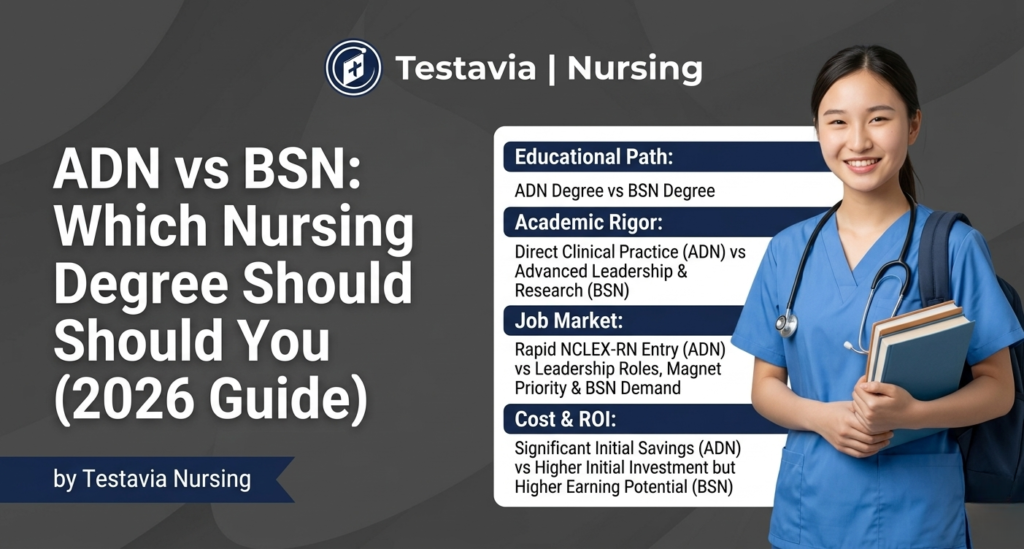
Should you spend two years or four years becoming a nurse?
That’s the core question when choosing between an Associate Degree in Nursing (ADN) and a Bachelor of Science in Nursing (BSN). Both qualify you to take the NCLEX-RN and become a registered nurse. Both prepare you for patient care. Both lead to nursing careers.
But they’re not the same. One gets you working faster. The other opens more doors long-term.
The decision isn’t just about time or money. It’s about where you want your nursing career to go. Direct bedside care for your entire career? An ADN works. Leadership roles, specialized positions, or graduate school? You’ll need a BSN eventually.
Understanding the real differences, not just the obvious ones like program length helps you choose the path that matches your goals. Many students strategically prepare for nursing entrance exams through Testavia while simultaneously researching degree options, entering school knowing exactly why they chose their path and what comes next.
This guide breaks down ADN vs BSN across every factor that matters: time, cost, salary, job opportunities, career advancement and the bridge programs that connect them.
What Is an ADN?
An Associate Degree in Nursing is a two-year undergraduate degree that prepares you for entry-level nursing positions.
Program Length
Most ADN programs take 2-3 years to complete. The degree itself is two years. However, you typically need to complete prerequisite courses first—anatomy, microbiology, chemistry, psychology.
If you complete prerequisites separately, total time is closer to 3 years. If you knock out prerequisites while taking ADN courses, you might finish in 2-2.5 years.
Where ADN Programs Are Offered
Community colleges primarily offer ADN programs. Some four-year universities offer them too, but community college ADN programs are more common and usually less expensive.
What You Learn
ADN programs focus on clinical skills and technical nursing competencies. Core courses cover:
Medical-surgical nursing, pharmacology, maternal-child health, mental health nursing, clinical rotations in hospitals and healthcare facilities.
The curriculum prepares you to pass the NCLEX-RN and provide safe, competent patient care.
Cost
ADN programs are typically more affordable because community college tuition is lower than university tuition.
Average cost: $6,000-$20,000 total for the entire program, depending on whether you attend in-state public community college or private institution.
Career Outcomes
ADN graduates work as registered nurses in hospitals, clinics, long-term care facilities, and home health. They provide direct patient care; administering medications, monitoring vital signs, documenting care, educating patients.
What Is a BSN?
A Bachelor of Science in Nursing is a four-year undergraduate degree that includes nursing courses plus broader education in leadership, research and public health.
Program Length
Traditional BSN programs take four years. This includes general education requirements (English, math, sciences) plus nursing coursework and clinical rotations.
Accelerated BSN programs for students who already have a bachelor’s degree in another field can be completed in 12-18 months.
Where BSN Programs Are Offered
Universities and four-year colleges offer BSN programs. Some community colleges partner with universities to offer “2+2” programs—two years at community college, two years at university for BSN completion.
What You Learn
BSN programs cover everything ADN programs cover, plus:
Nursing research and evidence-based practice, leadership and management, community and public health nursing, healthcare policy, advanced pathophysiology.
The additional coursework prepares BSN nurses for complex clinical situations, leadership roles, and graduate education.
Cost
BSN programs cost more because university tuition exceeds community college rates.
Average cost: $40,000-$100,000+ total depending on public vs private university and in-state vs out-of-state tuition.
Financial aid, scholarships, and employer tuition assistance can significantly reduce costs.
Career Outcomes
BSN graduates work in the same bedside RN roles as ADN nurses initially. However, BSN opens doors to:
Nurse manager and director positions, specialized units (ICU, ER, OR often prefer BSN), Magnet-designated hospitals (strongly prefer or require BSN), public health and community health roles, foundation for graduate degrees (MSN, DNP, PhD).
The Salary Difference: Does BSN Pay More?
Yes. BSN nurses earn more than ADN nurses on average.
According to Nurse.org, one of the leading resources for nursing professionals, BSN-prepared nurses consistently earn higher salaries than ADN nurses throughout their careers. The salary gap exists at entry level and widens significantly with experience, particularly as BSN nurses qualify for leadership and specialized positions that command premium pay.
Starting Salaries
BSN nurses typically start around $70,000 annually, while ADN nurses start around $60,000. That’s roughly a $10,000 difference at entry level.
However, starting salaries vary significantly by location. California RNs (regardless of degree) earn considerably more than RNs in lower cost-of-living states.
Mid-Career Salaries
The gap widens with experience.
Mid-career BSN nurses earn approximately $90,000, compared to ADN nurses earning around $80,000.
Overall, BSN nurses earn about $18,000 more annually than ADN nurses on average.
Why the Difference?
BSN nurses qualify for higher-paying positions. Nurse manager, clinical educator, case manager, and specialized roles typically require BSN and pay more than staff nurse positions.
Additionally, some hospitals pay differential rates for BSN nurses even in the same role.
Lifetime Earnings
Over a 30-40 year nursing career, the salary difference compounds significantly. The additional two years earning a BSN instead of working as an ADN nurse initially may be offset by higher lifetime earnings.
Job Opportunities: Where Can You Work?
Both ADN and BSN nurses work as registered nurses. Both take the same NCLEX-RN exam. Both hold RN licenses.
However, hiring preferences differ.
Hospital Hiring Trends
According to recent employment surveys, over 1 in 4 employers (28%) require new RN hires to have a BSN degree, with approximately 72% reporting a strong preference for BSN-prepared nurses.
This trend is accelerating. Hospitals increasingly prefer BSN nurses because research shows better patient outcomes when nursing staff holds bachelor’s degrees.
Magnet Hospitals
Magnet-designated hospitals those recognized for nursing excellence by the American Nurses Credentialing Center have specific BSN requirements.
While Magnet hospitals don’t require 100% of staff nurses to hold BSNs, almost 50% of direct care RNs hired by Magnet institutions do hold Bachelor’s degrees, and all nurse managers and nurse leaders must hold BSN or higher.
If you want to work at a prestigious Magnet hospital, BSN significantly improves your chances of getting hired.
Settings Where ADN Thrives
ADN nurses find strong job opportunities in:
Long-term care facilities and nursing homes, rehabilitation centers, home health agencies, rural hospitals (where BSN requirements are less strict), outpatient clinics.
These settings value clinical skills and often don’t require BSN for staff nurse positions.
Career Advancement
This is where BSN pulls decisively ahead.
Leadership positions: nurse manager, director of nursing, chief nursing officer almost universally require BSN minimum, often MSN.
Specialized roles—nurse educator, case manager, infection control nurse typically require BSN.
Graduate programs require BSN for admission. If you want to become a nurse practitioner, nurse anesthetist, clinical nurse specialist or pursue a PhD, you need BSN first.
Time to Degree: Which Gets You Working Faster?
ADN wins on speed.
ADN Timeline
Prerequisites: 1 year
ADN program: 2 years
Total: 3 years from start to RN license
You’re earning RN salary by age 24-25 if you start right after high school.
BSN Timeline
Prerequisites + program: 4 years
Total: 4 years from start to RN license
You’re earning RN salary by age 25-26 if you start right after high school.
The One-Year Difference
That one extra year matters if you need income immediately or want to start working sooner. However, that year might be offset by higher lifetime earnings with BSN.
Understanding how long each nursing path takes and what comes after helps you plan realistically. Our detailed guide on how long nursing school takes breaks down timelines for ADN, traditional BSN, accelerated BSN, and bridge programs, so you can map your path from application through licensure and understand exactly when you’ll start earning.
Cost Comparison: Which Is More Affordable?
ADN is significantly less expensive upfront.
ADN Costs
Tuition: $6,000-$20,000 total
Books and fees: $2,000-$4,000
Living expenses: $24,000-$36,000 (2-3 years)
Total: $32,000-$60,000
BSN Costs
Tuition: $40,000-$100,000+ total
Books and fees: $4,000-$8,000
Living expenses: $48,000-$72,000 (4 years)
Total: $92,000-$180,000+
Return on Investment
BSN costs 2-3 times more than ADN. However, higher salary partially offsets this.
If BSN nurses earn $10,000-$18,000 more annually, the additional tuition cost is recovered within 5-10 years through higher earnings.
Scholarships and Employer Support
Many hospitals offer tuition reimbursement for nurses pursuing BSN. Some will pay for your entire RN-to-BSN program if you commit to working for them after graduation.
This makes BSN more accessible than sticker price suggests.
ADN to BSN Bridge Programs: The Best of Both Worlds?
You don’t have to choose permanently. Many nurses start with ADN, work as RNs, then complete BSN through bridge programs.
How RN-to-BSN Programs Work
These programs are designed specifically for practicing RNs who already hold ADN. They grant credit for your ADN nursing courses and focus on BSN-specific content: leadership, research, public health.
Program length: 12-24 months (part-time while working full-time)
Format: Primarily online with some clinical or practicum hours
Cost: $15,000-$40,000 depending on institution
Benefits of the ADN-to-BSN Path
Start earning RN salary sooner (after 2-3 years instead of 4). Lower initial education debt. Employer often pays for BSN completion. Gain real-world nursing experience before pursuing advanced degree.
Downsides
Takes longer overall (ADN + bridge = 5-6 years total). You’re juggling work and school. Some hospitals won’t hire ADN nurses initially, forcing you into settings you didn’t prefer.
Who This Path Suits
This works well if you:
Need to work while in school due to financial constraints. Want hands-on nursing experience before pursuing leadership. Have an employer who will pay for BSN. Aren’t sure yet whether you want to pursue graduate education.
Which Degree Should You Choose?
There’s no universal “right” answer. The best choice depends on your circumstances and goals.
Choose ADN If:
You need to start working quickly. Two years gets you to RN faster than four.
Cost is a major concern. Community college ADN is significantly less expensive.
You’re content with bedside nursing. If you want direct patient care long-term without management aspirations, ADN suffices.
You plan to do RN-to-BSN later. Start earning sooner, then let your employer pay for BSN completion.
You’re unsure about nursing. Lower investment means less financial risk if you discover nursing isn’t for you.
Choose BSN If:
You want maximum career flexibility. BSN opens doors ADN doesn’t.
You’re interested in leadership or specialized roles. Nurse manager, educator, case manager typically require BSN.
You plan to pursue graduate education. MSN, DNP, PhD programs require BSN for admission.
You want to work at Magnet hospitals. These prestigious facilities strongly prefer BSN nurses.
You can afford the time and cost. If you have four years and can manage university tuition, BSN is the stronger long-term investment.
Future Trends: Where Is Nursing Education Heading?
The trend is clear: healthcare is moving toward BSN as the standard.
The 80% Goal
The Institute of Medicine recommended in 2010 that 80% of RNs hold BSN degrees by 2020. According to the American Association of Colleges of Nursing (AACN), the nation’s leading voice for baccalaureate and graduate nursing education, progress toward this goal continues despite not meeting the original timeline. The AACN reports that employer preferences increasingly favor BSN-prepared nurses, with research consistently showing correlations between higher nursing education levels and improved patient outcomes.
While that goal wasn’t met, progress continues.
Employment projections show demand for RNs growing 5% by 2034, but BSN-prepared nurses have better employment prospects than ADN nurses.
State Requirements
Some states are considering or implementing BSN requirements. New York passed legislation requiring RNs to obtain BSN within 10 years of initial licensure.
Other states are discussing similar policies.
Employer Requirements Tightening
More hospitals are requiring BSN for new hires. The percentage of employers requiring BSN has increased steadily over the past decade.
What This Means for You
If you’re starting nursing school in 2026, plan for a future where BSN is increasingly expected. Starting with ADN isn’t wrong, but plan to complete BSN within 5-10 years to remain competitive.
The reality of nursing school difficulty is another consideration. Whether you choose ADN or BSN, nursing school is rigorous and demanding. Our detailed breakdown of what nursing school is really like covers the academic intensity, clinical demands, time commitment and stress levels for both ADN and BSN programs, so you can prepare mentally and practically for whichever path you choose.
Making Your Decision
Consider these questions:
What are your financial constraints? Can you afford four years of university tuition, or do you need the lower cost of community college?
How quickly do you need to work? Do you need RN income in 2-3 years, or can you wait 4 years?
What are your long-term career goals? Bedside nursing forever, or leadership and specialization?
What are your local hospital hiring practices? Research hospitals in your area. Do they hire ADN nurses, or require BSN?
Are you interested in graduate school eventually? If yes, BSN is your starting point.
Will your future employer pay for BSN? If you can get ADN now and employer-funded BSN later, that’s worth considering.
Conclusion
ADN and BSN both lead to RN licensure. Both prepare you for patient care. Both are valid paths to nursing.
ADN gets you working faster and costs less upfront. It’s the practical choice if speed and affordability are your top priorities. BSN opens more doors long-term. It’s the strategic choice if you want maximum career flexibility and advancement opportunities.
Many nurses successfully start with ADN and bridge to BSN later. This path lets you earn RN salary sooner while still achieving bachelor’s education. The “best” choice is the one that aligns with your circumstances, goals, and priorities. Both paths lead to rewarding nursing careers. Both allow you to make a difference in patients’ lives. Both offer job security and solid income.
Choose the path that fits your situation. Then commit to it fully.
You’re going to be a great nurse either way.