

You’re staring at nursing program websites, trying to figure out how long this is actually going to take. One site says 2 years. Another says 4. Someone on Reddit swears they did it in 12 months. What’s the truth?
Here’s the honest answer: nursing school takes anywhere from 12 months to 6+ years, depending on which program you choose, whether you go full-time, and what credentials you already have.
That’s a huge range. And picking the wrong path can cost you years of your life and tens of thousands of dollars. So let me break down every nursing program by length, what it qualifies you for, and who each one is actually right for.
Quick Answer: Nursing School Length by Program
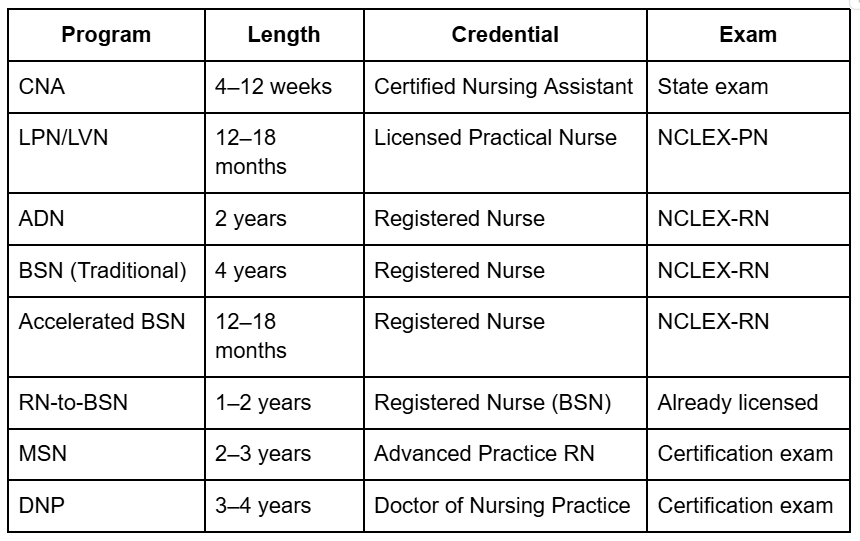
Now let’s get into what each one actually looks like.
CNA Programs: 4 to 12 Weeks
A Certified Nursing Assistant program isn’t technically “nursing school,” but many people start here. It’s the fastest way to get into healthcare and see if the field is right for you before committing years of your life.
CNA programs typically run 4 to 12 weeks. You’ll learn basic patient care, vital signs, hygiene assistance, and safety protocols. After finishing the coursework and clinical hours, you take your state’s CNA exam.
Who it’s for: People testing the waters, pre-nursing students wanting healthcare experience, or anyone who needs to start earning money in healthcare fast.
Plenty of nursing students work as CNAs while finishing their degree. It pays the bills and gives you real patient care experience that strengthens your nursing school application.
LPN/LVN Programs: 12 to 18 Months
Licensed Practical Nurses (called LVNs in California and Texas) complete their training in about a year to 18 months. You’ll take courses in pharmacology, anatomy, nursing fundamentals, and complete clinical rotations.
After graduation, you sit for the NCLEX-PN exam. Pass it, and you’re licensed to work.
LPNs work in nursing homes, doctor’s offices, home health and some hospital settings. The scope of practice is narrower than an RN’s, but the path in is much faster.
Who it’s for: Students who need to start working quickly, parents balancing family and school, or anyone planning to later bridge into an RN program.
One thing to know: LPN job opportunities in hospitals have shrunk in recent years. Many hospitals now hire only RNs. But long-term care, clinics, and outpatient settings still need LPNs badly.
ADN Programs: 2 Years
The Associate Degree in Nursing is the fastest way to become a Registered Nurse. Most ADN programs take 2 years if you go full-time, though prerequisites can add another semester or two depending on what courses you’ve already taken. If speed is your top priority, our guide on the quickest way to become a registered nurse breaks down every shortcut available.
You’ll study anatomy, physiology, microbiology, pharmacology, mental health nursing, maternal-child nursing, and complete hundreds of clinical hours. After graduation, you take the NCLEX-RN.
Pass it and you’re a Registered Nurse with the same license as someone who spent 4 years in a BSN program.
Who it’s for: Students who want to become an RN quickly, people on a tight budget (community college ADNs are often dramatically cheaper than BSN programs), or anyone who plans to do an RN-to-BSN bridge later.
Here’s the catch. Many hospitals especially magnet hospitals now prefer or require BSN-prepared nurses. You can still get hired with an ADN but your options may be narrower in big urban hospital systems. A lot of ADN grads start working, let their employer help pay for the bridge to BSN, and upgrade later.
Not sure if you can even get into a nursing program right now? Check out our guide to the easiest nursing schools to get into for programs with more flexible admission standards.
Traditional BSN Programs: 4 Years
The Bachelor of Science in Nursing is the full four-year university route. You’ll complete general education requirements for about two years, then move into the nursing major for the final two years.
BSN programs go deeper than ADN programs. You’ll study community health, nursing research, leadership, informatics and public health on top of everything an ADN covers. Clinical hours are usually more extensive.
Graduates take the NCLEX-RN, the same licensing exam ADN students take.
Who it’s for: Traditional students coming straight from high school, anyone wanting the widest job opportunities or students aiming for specialty roles, leadership, or graduate school down the road.
According to the American Association of Colleges of Nursing, BSN-prepared nurses generally have an easier time getting hired at major hospitals, earn slightly higher salaries on average, and have a clearer path into advanced practice later.
Accelerated BSN Programs: 12 to 18 Months
Already have a bachelor’s degree in another field? The Accelerated BSN (ABSN) is built for you.
ABSN programs cram a full BSN curriculum into 12 to 18 months of intense, full-time study. No breaks. No part-time option. These programs assume you already completed your general education somewhere else, so they skip straight to nursing coursework and clinicals.
Fair warning: ABSN programs are brutal. Students routinely describe them as the hardest year of their lives. You’re studying 50+ hours a week, handling clinicals and absorbing an enormous amount of information in a short window.
But if you’re career-changing and already have a degree, this is often the fastest and most efficient route to becoming an RN.
Who it’s for: Career changers with a non-nursing bachelor’s who want to become a nurse fast.
RN-to-BSN Bridge Programs: 1 to 2 Years
Already an RN with an ADN or diploma? The RN-to-BSN bridge finishes your bachelor’s degree in 1 to 2 years, usually online and part-time so you can keep working.
Most programs are fully online or hybrid. You won’t repeat the clinical hours you already did. Instead, the coursework focuses on leadership, research, community health, and the theoretical depth BSN programs emphasize.
Who it’s for: Working RNs who want better job prospects, higher pay, or plan to pursue graduate-level nursing.
Lots of hospitals offer tuition reimbursement for RN-to-BSN programs. If you’re already working as an RN, ask your employer about education benefits before you pay out of pocket.
MSN Programs: 2 to 3 Years
A Master of Science in Nursing takes you into advanced practice. Nurse Practitioners, Clinical Nurse Specialists, Nurse Educators and Nurse Administrators all come through MSN programs.
Most MSN programs take 2 to 3 years of full-time study after your BSN. Part-time options exist and can stretch the timeline to 4 or 5 years.
You’ll choose a specialty track early. Family Nurse Practitioner (FNP) is the most common but there are plenty of others… psychiatric, pediatric, acute care, women’s health and more. After graduation, you’ll take a specialty certification exam.
Who it’s for: BSN-prepared RNs who want to diagnose, prescribe and practice with more autonomy, or move into teaching, research or administration.
The Bureau of Labor Statistics projects nurse practitioner jobs to grow over 40% through 2033 faster than almost any other profession in the country.
DNP Programs: 3 to 4 Years
The Doctor of Nursing Practice is the terminal degree for advanced practice nurses. It takes 3 to 4 years after a BSN or 1 to 2 years after an MSN.
DNPs do the clinical work of an NP but with deeper training in leadership, systems-level thinking, and evidence-based practice. The field is pushing toward requiring a DNP for advanced practice roles though the MSN is still widely accepted.
Who it’s for: Nurses aiming for the highest level of clinical practice, leadership positions, or academic careers.
What Actually Affects How Long Nursing School Takes
The program length is just a starting point. Your real timeline depends on several factors.
Prerequisites. Most ADN and BSN programs require anatomy, physiology, microbiology, chemistry, English, and statistics before you can start the nursing portion. If you haven’t taken these, add 1–2 semesters.
Full-time vs. part-time. Part-time programs double your timeline. A 2-year ADN can become a 4-year journey if you can only go part-time.
Waitlists. Many community college ADN programs have waitlists of 1–3 years because demand far exceeds capacity. You might be accepted but still waiting to actually start classes.
Clinical scheduling. Clinicals happen at specific times at specific hospitals. If you can’t make the available slots because of work or childcare, your timeline stretches.
Failing or repeating courses. Nursing programs often require a C or better in every course. Fail one, and you might have to wait an entire year to retake it (nursing courses usually only run once per year).
How to Finish Nursing School Faster
Some of this is in your control.
Complete prerequisites before applying. If you have your anatomy, physiology, and microbiology done with strong grades before you apply, you can jump straight into the nursing portion when accepted.
Apply to multiple programs simultaneously. Waitlists are brutal. Applying broadly increases your chances of starting sooner.
Consider programs without the TEAS. If the TEAS is your bottleneck, nursing schools that don’t require the TEAS exam can help you start sooner.
Keep your GPA strong. Most nursing programs won’t let you continue with grades below a C in nursing courses. Failing means waiting a full year to retake. Staying on track is the single biggest factor in finishing on time.
Learn to study smart. Nursing school is a firehose of information. The students who finish on time aren’t the ones studying 16 hours a day they’re the ones studying efficiently. Our guide on how to study less and get better grades as a nursing student covers the exact methods that work.
Which Nursing Path Should You Choose?
Pick ADN if: you want to become an RN fast, keep costs low, or plan to bridge to BSN later while working.
Pick BSN if: you’re starting fresh from high school, want the widest job options, or plan to pursue graduate school.
Pick ABSN if: you already have a bachelor’s in another field and want to switch to nursing quickly.
Pick LPN if: you need to start working in healthcare soon and may bridge to RN later.
Pick RN-to-BSN if: you’re already an RN and want to advance your career or salary.
Pick MSN or DNP if: you want to become a Nurse Practitioner, educator, administrator, or pursue advanced clinical practice.
Getting Through Nursing School
However long your program is, the goal is to finish it and finish it well. Nursing school is academically brutal, but it’s survivable with the right tools.
Testavia is built for overwhelmed nursing students. Practice questions that mirror your real exams, visual study guides that make nursing concepts click, and structured learning that keeps you on track when your schedule falls apart.
Try it free for 7 days. No credit card required.
Frequently Asked Questions
The LPN/LVN is the shortest nursing-specific program at about 12 months. If you’re set on becoming an RN, the ADN at 2 years or the Accelerated BSN at 12–18 months (for career changers) are your fastest options.
Only if you already have a bachelor’s degree and enroll in an Accelerated BSN program, or if you pursue an LPN license. Becoming an RN from scratch takes a minimum of 2 years.
Yes. An ADN from an ACEN-accredited program qualifies you to take the NCLEX-RN and become a licensed Registered Nurse. You can work in hospitals, clinics, long-term care, and most nursing settings. But some major hospital systems now prefer or require a BSN.
Most nursing students say yes. The combination of heavy coursework, clinical rotations, high-stakes exams, and emotional intensity makes it one of the toughest undergraduate programs. But it’s completely doable with good study habits and support.
Part-time, yes. Full-time, usually not. Nursing programs are demanding and clinical rotations often happen on weekdays. Many students work as CNAs or unit secretaries on weekends or evenings to keep a foot in healthcare while studying.
Plan on 6–8 years total. That’s 4 years for a BSN, 1–2 years working as an RN (most MSN programs want clinical experience) and 2–3 years for an MSN. If you pursue a DNP instead, add another year or two.