

You take a practice test. Score 72%. It feels pretty good and you move on to the next topic. Three weeks later, you sit for the real TEAS. Same topics. Same question types. But somehow, you’re blanking. The score comes back: 68%.
What happened?
Here’s the brutal truth: most students use practice tests completely wrong. They treat them as quizzes to check knowledge instead of powerful learning tools that could double their retention. Without the right practice test strategy, you’re wasting hours on activities that don’t improve your score.
Research from cognitive psychology reveals that students who properly leverage practice testing score 34% higher on exams than those using traditional study methods alone. However, the difference isn’t how many practice tests you take, it’s how you use them.
Students preparing through Testavia learn that practice tests aren’t about getting questions right. They’re about training your brain to retrieve information under pressure, identifying knowledge gaps, and building test-taking stamina.
This guide breaks down the 7 biggest mistakes students make with practice tests, why they sabotage your score, and exactly how to use practice tests strategically for TEAS, nursing school exams, and NCLEX.
The 7 Deadly Practice Test Mistakes
Mistake #1: Looking Up Answers Mid-Test
What Students Do: Take a practice test with their notes open. See a tough question. Quickly peek at their study guide. “Just to confirm,” they tell themselves.
Why This Kills Your Progress: Every time you look up an answer mid-test, you rob your brain of the struggle that creates learning. Research on retrieval practice shows that the cognitive effort of trying to recall information—even when you fail—strengthens memory pathways far more than passive recognition.
When you peek at notes, you’re testing recognition (seeing the answer and thinking “oh yeah, I knew that”) instead of recall (pulling information from memory without cues). Recognition feels easier. Recall builds real learning.
What To Do Instead:
- First, close all notes, textbooks, and study materials before starting
- Next, set a timer matching real test conditions
- Then, force yourself to attempt every question, even if you have to guess
- Finally, mark questions you’re unsure about but don’t look them up until after
TEAS-Specific Application: The TEAS doesn’t give you hints. You won’t have notes. Practice the way you’ll perform. Take every practice test as if it’s the real exam.
Mistake #2: Only Taking Practice Tests Once You “Feel Ready”
What Students Do: “I’ll take a practice test after I finish studying this chapter… and the next one… maybe after I review everything one more time.”
They wait until they feel confident. By then, it’s three days before the exam.
Why This Kills Your Progress: Studies from educational psychology demonstrate that practice testing is studying, not just assessment. Students who integrate practice tests throughout their preparation starting early retain significantly more information than those who wait until the end.
Early practice tests reveal gaps before they become crises. Late practice tests just confirm what you don’t know with no time to fix it.
What To Do Instead:
- Initially, take a diagnostic practice test BEFORE you start studying (baseline)
- Then, take mini-quizzes (10-15 questions) after each study session
- Subsequently, take full-length practice tests every 7-10 days during prep
- Finally, schedule your last full practice test 3-5 days before exam day (not the night before)
TEAS Timeline Example:
- Week 1: Diagnostic test (shows where to focus)
- Week 2: Section quizzes (math, reading, science, English)
- Week 3: Full practice test #1
- Week 5: Full practice test #2
- Week 7: Full practice test #3
- 2-3 days before TEAS: Light review only (no new practice tests)
Mistake #3: Not Reviewing Wrong Answers Thoroughly
What Students Do: Finish a practice test. Check the score. “Oh, I got 78%. Not bad.”
Scroll through the answers. “Hmm, missed that one. Okay, next.”
Five minutes later, they’re done “reviewing.”
Why This Kills Your Progress: The gold is in the mistakes. Research findings from learning science institutions confirm that students who thoroughly analyze their errors turn practice tests into powerful diagnostic tools that accelerate learning.
If you don’t understand WHY you got a question wrong, you’ll get it wrong again on the real test. And again. And again.
What To Do Instead: Spend 2-3x more time reviewing than testing. For every 1 hour of practice testing, spend 2-3 hours analyzing mistakes.
The Mistake Analysis Protocol:
For EVERY wrong answer, ask yourself:
1. What was the question actually asking?
- Did I misread it?
- Did I miss a keyword (NOT, EXCEPT, MOST likely)?
2. Why is the correct answer correct?
- What concept does it test?
- What makes it better than my answer?
3. Why did I choose the wrong answer?
- Did I not know the content?
- Did I know it but forgot under pressure?
- Did I fall for a distractor?
4. What do I need to review?
- Specific topic (e.g., nervous system anatomy)
- Question type (e.g., inference questions in reading)
- Test-taking strategy (e.g., eliminating impossible answers)
5. How can I avoid this mistake on the real test?
- Create a flashcard
- Review similar questions
- Note patterns in the types of questions I miss
Mistake #4: Focusing Only On Your Score
What Students Do: Take five practice tests. Get 70%, 73%, 71%, 74%, 72%.
“I’m stuck at 72%. What’s wrong with me?”
Why This Kills Your Progress: Your score is a lagging indicator. It tells you what already happened. Your mistake patterns are leading indicators. They tell you what to fix.
Students who fixate on scores miss critical diagnostic information hiding in their performance data.
What To Do Instead: Track performance by section and topic, not just overall score.
Create a Performance Tracker:
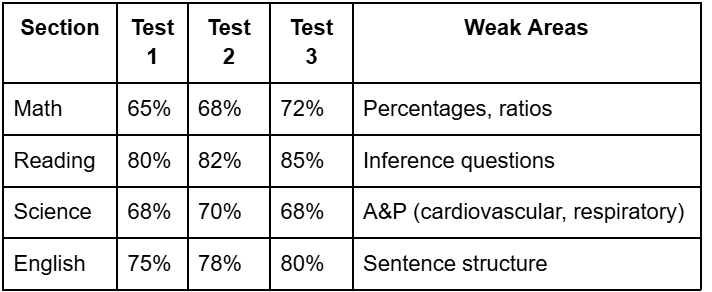
What This Reveals:
- Math improving steadily → current study method working
- Science stuck at 68-70% → need different approach
- Specific topics to focus remaining study time on
Students often ask “Is nursing school hard?” The answer depends heavily on test-taking skills you build now during TEAS prep. Analyzing practice test patterns trains the diagnostic thinking you’ll need for nursing exams.
Mistake #5: Taking Practice Tests in “Comfort Mode”
What Students Do:
- Take test at home with TV in background
- Pause halfway through for a snack
- Look up one “quick” thing on their phone
- Let the cat walk across their keyboard
- Take breaks whenever they feel stuck
“I’ll focus better on the real test,” they think.
Why This Kills Your Progress: You don’t rise to the occasion—you default to your training level. If you practice in comfort mode, you’ll perform in panic mode when test conditions hit.
What To Do Instead: Simulate real test conditions exactly.
Test-Day Simulation Checklist:
✅ Timing: Set strict time limits (TEAS = 209 minutes for 170 questions)
- Math: 57 minutes / 38 questions
- Reading: 55 minutes / 45 questions
- Science: 60 minutes / 50 questions
- English: 37 minutes / 37 questions
✅ Environment:
- Quiet room (or use earplugs if your test center is noisy)
- Remove phone, notes, distractions
- Use only allowed materials (TEAS provides on-screen calculator)
✅ Breaks:
- No pausing mid-section (TEAS doesn’t allow this)
- Take a 10-minute break between sections if needed (some test centers allow this)
✅ Mindset:
- Treat it like the real exam
- Don’t pause to look things up
- Push through difficult questions
Mistake #6: Taking The Same Practice Test Multiple Times
What Students Do: “I’ll take this practice test until I get 90%.”
They take the same 50-question test five times. Score goes from 68% to 72% to 79% to 85% to 92%.
“I’m ready!”
They’re not. They memorized the answers to those 50 questions. They didn’t learn the underlying concepts.
Why This Kills Your Progress: You’re training answer recognition, not knowledge application. When the real test presents the same concept with different wording or a slightly different angle, you blank.
What To Do Instead:
- Never take the exact same practice test more than twice
- Space repeat attempts at least 14 days apart
- Focus on concept mastery, not memorizing specific questions
- Rotate through multiple question banks
TEAS Practice Test Strategy:
Official ATI practice tests provide the most accurate question format and difficulty. Use these strategically:
- Take official ATI Practice Test A at baseline (Week 1)
- Take official ATI Practice Test B midway through prep (Week 4)
- Save any additional official tests for Week 6-7
- Supplement with third-party question banks (Testavia, Mometrix, Trivium) for additional practice
Mistake #7: Not Tracking Time Per Question
What Students Do: Start practice test. Spend 5 minutes on question 3 because they really want to figure it out. Spend 8 minutes on question 12 because it’s tricky.
Get to question 40 with 10 minutes left. Panic. Rush through the rest. Miss easy questions they would’ve gotten if they had time.
Why This Kills Your Progress: The TEAS penalizes perfectionists. You have about 1 minute and 13 seconds per question. If you spend 3+ minutes on tough questions, you sacrifice time on easy questions.
Missing 3 hard questions = -3 points. Missing 7 easy questions because you ran out of time = -7 points.
What To Do Instead: The 90-Second Rule:
- Spend maximum 90 seconds per question
- If you don’t know the answer after 90 seconds, make your best guess and flag it
- If you finish early, go back to flagged questions
- Never leave questions blank (there’s no penalty for guessing)
Time Management By Section:
Math (57 min / 38 questions = 1.5 min per question):
- Quick calculations: 30-45 seconds
- Word problems: 1.5-2 minutes
- Multi-step problems: 2-2.5 minutes
Reading (55 min / 45 questions = 1.2 min per question):
- Spend 2-3 minutes reading passages
- Spend 30-60 seconds per question
Science (60 min / 50 questions = 1.2 min per question):
- Recall questions: 30-45 seconds
- Application questions: 1-1.5 minutes
English (37 min / 37 questions = 1 min per question):
- Grammar rules: 30-45 seconds
- Sentence structure: 1-1.5 minutes
Practice Test Strategy: How To Actually Use Tests For Maximum Results
Now that you know what NOT to do, here’s the complete strategy:
The 5-Step Practice Test Protocol
Step 1: Simulate Real Conditions
- Set timer
- Close all materials
- Remove distractions
- Commit to finishing without pausing
Step 2: Take The Entire Test
- Flag difficult questions but don’t dwell
- Make educated guesses when stuck
- Track time per section
- Push through mental fatigue (this builds stamina)
Step 3: Score Immediately
- Check your overall score
- Calculate section scores
- Note timing (did you finish? rush? have extra time?)
Step 4: Deep Analysis (This Is Where Learning Happens)
- Review EVERY wrong answer using the Mistake Analysis Protocol
- Review correct answers you guessed on
- Identify patterns in mistakes
- Create targeted study list
Step 5: Targeted Review & Retry
- Study weak areas identified in analysis
- Retake similar questions (not the exact same test)
- Track improvement in specific categories
- Repeat cycle every 7-10 days
Practice Test Frequency Guide
6-8 Weeks Before Test:
- 1 diagnostic full-length test (baseline)
- 2-3 section quizzes per week
- Focus on learning, not testing
4-5 Weeks Before Test:
- 1 full-length test per week
- 3-4 section quizzes per week
- Balance testing with content review
2-3 Weeks Before Test:
- 2 full-length tests per week
- Daily section quizzes (15-20 questions)
- Shift focus toward weak areas
Final Week:
- 1 final full-length test (3-5 days before exam)
- Light topic review only
- No new practice tests last 48 hours (rest brain)
Tools & Resources For Practice Testing
Official TEAS Practice:
- ATI TEAS Online Practice Tests (most accurate format)
- ATI TEAS SmartPrep (adaptive practice)
Third-Party Question Banks:
- Testavia TEAS Practice (realistic questions + detailed explanations)
- Mometrix TEAS Practice Test Book
- Trivium Test Prep
Tracking Tools:
- Google Sheets (create performance tracker)
- Notion (organize mistake analysis)
- Excel (track score progression)
For Nursing Students: Many students wonder about the connection between TEAS preparation and nursing school success. Our guide on how long nursing school takes shows how strong test-taking skills developed during TEAS transfer directly to nursing program exams and eventually NCLEX.
Conclusion
Most students think practice tests measure what they know.
Wrong.
Practice tests BUILD what you know. They’re learning tools disguised as assessments.
The cognitive science is clear: retrieval practice, actively pulling information from memory creates stronger, more durable learning than any amount of passive review. When you take a practice test, you’re not checking if you learned. You’re learning.
But only if you use them correctly.
Stop treating practice tests like quizzes. Start treating them like training sessions. Simulate real conditions. Struggle with difficult questions. Spend hours analyzing mistakes. Track patterns. Target weak areas. Repeat.
This isn’t busywork. This is the most efficient way to prepare for any standardized test, especially the TEAS.
Students who master this practice test strategy don’t just pass TEAS they dominate it. And more importantly, they build test-taking skills that carry them through nursing school and NCLEX.
Start today. Take a practice test. Not to check what you know.
To learn what you don’t.