
Online nursing school has gone from a niche option to a mainstream path. Right now, more than half of U.S. postsecondary students take at least one online class and that shift has staying power well beyond the pandemic.
But popular doesn’t mean right for everyone. Nursing isn’t accounting or marketing — it’s a hands-on, high-stakes profession. And the decision to study online carries real consequences for how prepared you’ll feel on the floor.
If you’re weighing online nursing school and want a straight answer on whether it’s worth it, this is for you. We’ll cover what’s genuinely good about it, what people don’t warn you about, and a list of accredited programs to start your search. You can also check out our guide on how long nursing school takes to understand the full timeline before committing.
First: What Does “Online Nursing School” Actually Mean?
This is where most articles get vague. “Online nursing school” is not one thing — it’s a category that covers very different program types.
RN to BSN programs are the most common fully online option. If you’re already a licensed RN, these programs let you earn your Bachelor of Science in Nursing entirely (or almost entirely) online. Theory-heavy, minimal in-person requirements.
Pre-licensure programs — like ADN or BSN programs for people who aren’t nurses yet — are different. These can’t be fully online. You’ll complete nursing theory coursework online, but clinicals and simulation labs are always in person. Always. No exceptions, regardless of what a program’s marketing suggests.
RN to MSN and DNP programs follow a similar hybrid model. Online coursework, in-person clinical hours.
So when someone says “I’m doing online nursing school,” what they usually mean is: the academic coursework is online, but the hands-on components are not.
That distinction matters. A lot.
The Real Pros of Online Nursing School
Flexibility That Actually Fits Your Life
This is the biggest draw and it’s legitimate.
Online nursing programs allow students to balance schooling with personal and professional responsibilities. Unlike traditional programs with rigid schedules, online programs offer asynchronous classes, meaning students can study at times that suit their individual lives.
If you’re working as a CNA or patient care tech while finishing prerequisites or raising kids between shifts, flexibility isn’t a perk it’s a requirement. Online programs make it possible to study at 11pm after your kids are in bed, or at 6am before your shift. That’s real.
You Can Keep Working
Many students maintain their income and continue professional growth while pursuing their nursing degree earning and learning simultaneously is a genuine advantage for students who can’t afford to step away from work.
For a lot of nursing students, this is the whole point. Nursing school is expensive. Quitting your job to attend class full-time isn’t realistic. Online programs let you keep that income flowing while building toward your degree.
Lower Overhead Costs
No commute. No campus parking. No relocating for a program. For students in rural areas or states with limited nursing school options, online programs open up access to accredited institutions that would otherwise require a move.
You Can Rewatch Lectures
This sounds minor. It’s not. Online learning lets students complete interactive exercises, watch lectures, and go through modules multiple times to master material at their own pace. When you’re studying pharmacology or pathophysiology, being able to replay a lecture on cardiac output until it clicks is genuinely useful.
No Waitlists at Many Programs
Some online programs accept more students than traditional schools because online classrooms don’t impose physical space limitations meaning you could get started on your career sooner. Waitlists at traditional nursing schools can stretch 1–3 years. Online programs often don’t have that same bottleneck.
The Real Cons of Online Nursing School (The Ones People Gloss Over)
You Still Have In-Person Requirements and They’re Non-Negotiable
Let’s be direct: if a program tells you nursing can be learned 100% online, walk away. Clinical hours, simulation labs, and skills checkoffs require physical presence. There’s no digital substitute for practicing IV insertion, managing a simulated patient in a mock code, or doing a real clinical rotation in a hospital.
Even in hybrid programs, students must complete hands-on work in skills and simulation labs, and clinical rotations at healthcare facilities, these components cannot be completed remotely.
Before enrolling anywhere, ask: where are the labs located? How many clinical hours are required? Who arranges the clinical placements, you or the school? These answers will tell you more about the program than any marketing page.
Self-Discipline Is a Prerequisite, Not a Bonus Skill
Online learning works well for students who are self-motivated, organized, and consistent. It fails students who need external structure to stay on track.
Some students find it hard to study and work in the same space where they relax the home environment can actively work against focus. Nursing content is dense. Anatomy, physiology, pharmacology, pathophysiology none of it is content you can passively absorb. If you know you need a classroom structure to stay accountable, that’s not a weakness. It just means in-person is a better fit.
Isolation Is a Real Problem
Online nursing students often report feeling disconnected from classmates, from instructors, and from the culture of nursing itself. That matters more than it sounds.
Nursing is a team profession. The relationships you build in school, the study groups, the shared panic before an exam those create professional bonds that carry into your career. Online students miss a lot of that organic community-building.
You can compensate with intentional effort: joining nursing student forums, attending in-person labs as a social opportunity, finding a study group locally. But it takes deliberate work.
Accreditation Gaps Can Hurt Your Career
Not all online nursing programs are accredited the same way. The two major nursing accreditors are ACEN (Accreditation Commission for Education in Nursing) and CCNE (Commission on Collegiate Nursing Education). A degree from a non-accredited program can disqualify you from certain jobs, graduate programs, and even state licensure in some cases.
Before you enroll in any online nursing program, verify its accreditation status. Don’t assume — check. The ACEN and CCNE both publish their accredited program lists publicly.
Technology Problems Are Your Problem
As an online student, a high-speed internet connection is essential, and technical issues will come up being prepared for them matters. If your internet goes out the night an assignment is due, you need a backup plan. If your laptop fails before a proctored exam, you need to know exactly who to call. These happen regularly, and online programs have less patience for tech excuses than professors standing in front of you.
Online vs. In-Person Nursing School: The Honest Comparison
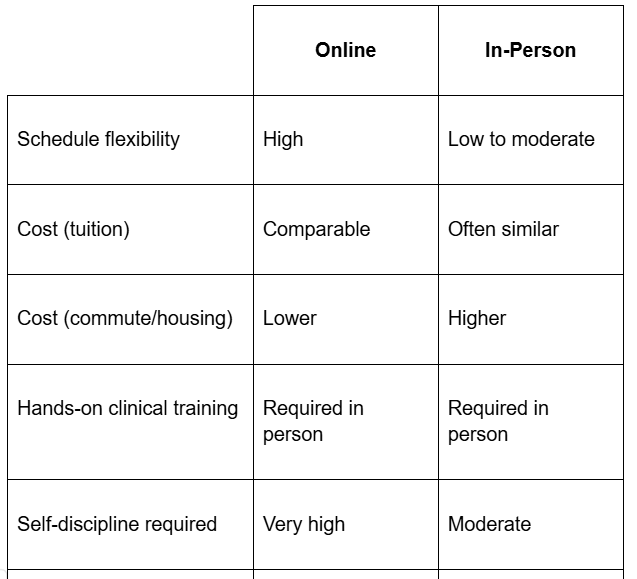
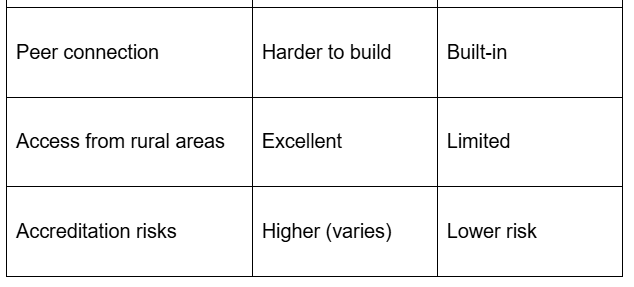
The clinical training row is the same for both because it has to be. That’s the equalizer. No matter where you study theory, you’re learning nursing with your hands in a real clinical environment.
Who Should Seriously Consider Online Nursing School
Online works well for you if:
- You’re an existing RN pursuing your BSN or MSN
- You have a stable job you can’t leave while studying
- You’re a highly self-directed learner with strong time management
- You live far from nursing programs with rigid in-person schedules
- You have family responsibilities that make fixed class times impossible
Online is probably not your best fit if:
- You’re just starting out and haven’t worked in a clinical environment yet
- You struggle to stay on task without external accountability
- You learn better by asking questions in real time and getting immediate feedback
- You’re hoping to avoid the in-person components entirely
There’s no shame in either answer. Nursing school is hard regardless of format — the question is which structure gives you the best shot at finishing.
Accredited Online Nursing Programs Worth Knowing
These are legitimate, accredited programs with established online tracks. This isn’t an exhaustive list — it’s a starting point for your research.
RN to BSN Online Programs:
- Western Governors University (WGU) — fully online, competency-based, CCNE-accredited
- University of Texas at Arlington — large online RN to BSN program, CCNE-accredited
- Indiana University East — affordable, CCNE-accredited online RN to BSN
- Grand Canyon University — CCNE-accredited, multiple nursing tracks online
Online MSN Programs:
- Walden University — CCNE-accredited, multiple nursing specializations
- South University — online MSN tracks including nursing education and leadership
- Purdue University Global — CCNE-accredited online MSN
Hybrid Pre-Licensure (Online Theory + In-Person Labs/Clinicals):
- Notre Dame of Maryland University ABSN — online coursework with in-person clinical placements
- Simmons University — hybrid ABSN option
- Chamberlain University — multiple hybrid nursing degree options
Before committing to any program, verify its current accreditation status at acenursing.org or ccneaccreditation.org and confirm clinical placement arrangements in your area.
The Bottom Line
Online nursing school is a legitimate, practical path for the right student. It won’t make nursing easier, and it won’t replace the clinical hours you need to become a competent nurse. But for students who are self-driven, already working in healthcare, and genuinely can’t commit to fixed classroom schedules, it removes real barriers.
The key is going in with eyes open. Check accreditation. Understand the in-person requirements. Be honest about whether you have the self-discipline online learning demands.
And if you do decide to go online treat it with the same seriousness you’d give a traditional program. Because the NCLEX doesn’t care how you studied.
Need help preparing for the TEAS before nursing school applications? Testavia has practice tools and resources built specifically for nursing students who need to study smart, not just more.