A BSN can cost $40,000 to $100,000. An MSN or DNP? Easily more and nursing school doesn’t just take money, it takes time. Most students can’t work full hours while managing clinical rotations and a full course load.
The good news: there’s a lot of money set aside specifically for nursing students. Federal programs, professional associations, hospital systems, state boards, private foundations, all of them fund nursing education because the country needs nurses. You just have to know where to look and when to apply.
This guide covers the best financial aid options for nursing students in 2026-2027 — real deadlines, real dollar amounts, and what each program actually requires. If you’re also prepping for the TEAS exam while figuring out funding, Testavia’s TEAS prep platform is built specifically for pre-nursing students juggling all of this at once.
Start Here: The FAFSA Is Step One, Not Optional
Before you apply for any scholarship, you need to fill out the FAFSA. Most people know it’s required for federal student loans. What’s less understood is that many private scholarships, hospital-based awards and nursing association grants also require it. Skipping it means you’re disqualifying yourself from more money than just the federal stuff.
The 2026-27 FAFSA opened on September 24, 2025. The federal deadline is June 30, 2027, but that number is misleading. File as early as October as possible.
Here’s why early matters: campus-based aid programs like the Federal Supplemental Educational Opportunity Grant (FSEOG) work on a first-come, first-served basis. Each school gets a fixed pool. When it’s gone, it’s gone. Students who file in October get access to the full pool. Students who file in March get what’s left. Research consistently shows that students who file in the first three months receive about twice as much grant money on average.
The 2026-27 maximum Pell Grant is $7,395. That’s the ceiling for students with the highest financial need. Your actual award depends on your Student Aid Index (SAI), family size, and enrollment status. Part-time students receive a prorated amount.
One note on the FAFSA itself: the 2026-27 version has been simplified significantly, down from over 100 questions to about 36, with tax data imported automatically from the IRS. The old Expected Family Contribution (EFC) is now called the Student Aid Index (SAI). The process is genuinely faster than it used to be.
Federal Scholarship Programs Worth Knowing
Nurse Corps Scholarship Program
This is the biggest federal scholarship specifically for nursing students, and it covers a lot. If you’re accepted, HRSA pays your full tuition, required fees, books and clinical supplies, and a monthly stipend of $1,642 for 2026-27. In exchange, you commit to working at least two years at a Critical Shortage Facility after graduation… a healthcare facility in an underserved area.
The 2026 application opened March 10 and closed April 9, 2026. Applications for 2027 will follow a similar spring cycle. Get on HRSA’s email list now so you’re notified the day it opens.
A few things to know before you apply:
- You must be enrolled full-time in an accredited U.S. nursing program
- U.S. citizenship or permanent residency required
- You can’t have existing federal service commitments or judgment liens
- HRSA gives priority to students with the most financial need
- The entire award is taxable income remember to budget for this
- Up to 25% of funding is reserved for women’s health NP and CNM pathways; another 25% for two-year ADN/ASN programs
The service commitment is real. This isn’t a scholarship you take and forget. But if you’re open to working in underserved communities — rural areas, community health centers, HPSAs, the financial payoff is significant.
Apply at: bhw.hrsa.gov/programs/nurse-corps/scholarship/apply
National Health Service Corps (NHSC) Scholarship
Similar structure to Nurse Corps but open to a broader set of health professions. Nurse practitioners qualify. The 2026 deadline was April 16, 7:30 p.m. ET. Coverage includes tuition, fees, a monthly living stipend, and an annual payment for other education costs. Only the stipend is taxable unlike Nurse Corps, where everything is taxable.
The service obligation is a minimum two years and maximum four years at an NHSC-approved site. The program is competitive: HRSA expects to fund roughly 10% of applicants. That’s worth knowing. It doesn’t mean don’t apply, it means write a strong application and apply early.
Apply at: nhsc.hrsa.gov/scholarships/how-to-apply
Nursing Association Scholarships
FNSNA Undergraduate Scholarship Program
The Foundation of the National Student Nurses Association awards over $500,000 annually to nursing students across the country. Individual awards go up to $10,000. The 2026 cycle had a January 9, 2026 deadline; for the 2026-27 cycle, check fnsna.org for the updated date applications typically open in September.
Who qualifies: students enrolled in accredited ADN, BSN, diploma, direct-entry MSN, RN-to-BSN or accelerated BSN programs. You need at least 6 credits per semester and a graduation date after July 1, 2026. Selection is based on academic performance, financial need, and involvement in nursing student organizations or community health activities.
This is one of the better scholarships to apply for early in your nursing program because it doesn’t require NSNA membership, and the award can be used for tuition, fees, books, and clinical supplies.
Apply at: fnsna.org/scholarships
AACN QGenda Scholarship
The American Association of Colleges of Nursing (AACN) runs several scholarship programs throughout the year. The QGenda-AACN Scholarship is worth $5,000 and available to students in BSN, accelerated, and graduate programs at AACN member schools.
It runs three funding cycles:
- Cycle 1: May 1 – July 1
- Cycle 2: August 1 – October 1
- Cycle 3: December 1 – February 1 (this cycle is specifically designated for accelerated BSN and master’s students)
If your school is an AACN member institution, this is one of the first places to look. The December-February cycle is especially worth flagging for ABSN students.
AACN Hurst Review Scholarship
A partnership between Hurst Review Services and AACN, this $2,500 scholarship is for entry-level baccalaureate nursing students. You need a 3.2 GPA minimum, be graduating within 6-12 months and be enrolled at an AACN member school. The application opens June 30 and closes September 1. Worth bookmarking if you’re in your final year.
AACN NurseThink Graduate Scholarship
For master’s and doctoral students who want to become nurse faculty. Two deadlines each year: January 31 and July 15. You need to be a member of the Graduate Nursing Student Academy (GNSA) which is free to join and have a 3.5 GPA. Award is $5,000. This one rewards academic strength and a stated interest in teaching nursing.
State Programs and Hospital-Based Aid
Federal and association scholarships get most of the attention, but state-level programs are often less competitive and just as valuable. A few worth knowing:
Illinois Nursing Education Scholarship (NES)
For Illinois residents enrolled in approved nursing programs, awards up to $5,000 per year with a service commitment to practice in Illinois after graduation. The 2026-27 application window ran March 1 through April 30, 2026. Apply through the ISAC student portal.
Kentucky Board of Nursing Scholarship
Available to Kentucky residents in LPN, ADN, BSN, or graduate programs. Recipients work full-time as a nurse in Kentucky for each year of funding received. Deadline varies by program level; check the Kentucky Board of Nursing directly.
Nearly every state has something similar. If you haven’t checked your state board of nursing’s website for financial aid programs, do it today. Many students miss these entirely because they only search national scholarships.
Hospital and Health System Tuition Assistance
Many hospitals offer tuition reimbursement or scholarships in exchange for a service commitment after graduation. This is separate from federal programs, it’s a direct employer-to-student arrangement. Large health systems like HCA, Ascension, CommonSpirit and Banner Health all have programs.
If you’re already working as a CNA, patient care technician, or in any healthcare support role, ask your HR department what’s available. The commitment varies (usually 1-2 years of employment), but the dollar amounts can be significant. Some hospitals will cover your entire BSN in exchange for working there afterward.
How to Build a Scholarship Strategy That Actually Works
Apply early and apply often
Most students apply for one or two scholarships and treat it as done. The ones who get funded treat scholarship applications like a part-time job. Set a goal of applying to 5-10 scholarships per month. Many awards are under $2,500. They don’t feel life-changing individually but they stack.
Read the eligibility requirements carefully
One of the most common application mistakes is applying for scholarships you don’t qualify for. Wrong degree level, wrong state, wrong GPA, wrong graduation date. It wastes your time and the committee’s. Read everything before you start filling out the form.
FAFSA first, always
You cannot be considered for many scholarships, especially need-based ones, without a submitted FAFSA. Some scholarship committees won’t even look at your application without a financial aid certification form from your school. Submit the FAFSA as early as possible, then start applying for scholarships.
Essays matter more than people think
Generic essays lose. Committees read hundreds of them. The ones that stand out are specific: a patient you cared for, a moment that made you certain nursing was the right path, a specific population you want to serve. Don’t write the essay the scholarship organization expects. Write the one only you could write.
Document everything
Keep a running list of every scholarship you’ve applied for: name, deadline, award amount, result. This helps you track what’s pending, follow up when needed, and build a better pipeline for next year. Clinical hours, volunteer work, GPA, NSNA involvement — document it all in one place so you’re not scrambling to find information when an application asks for it.
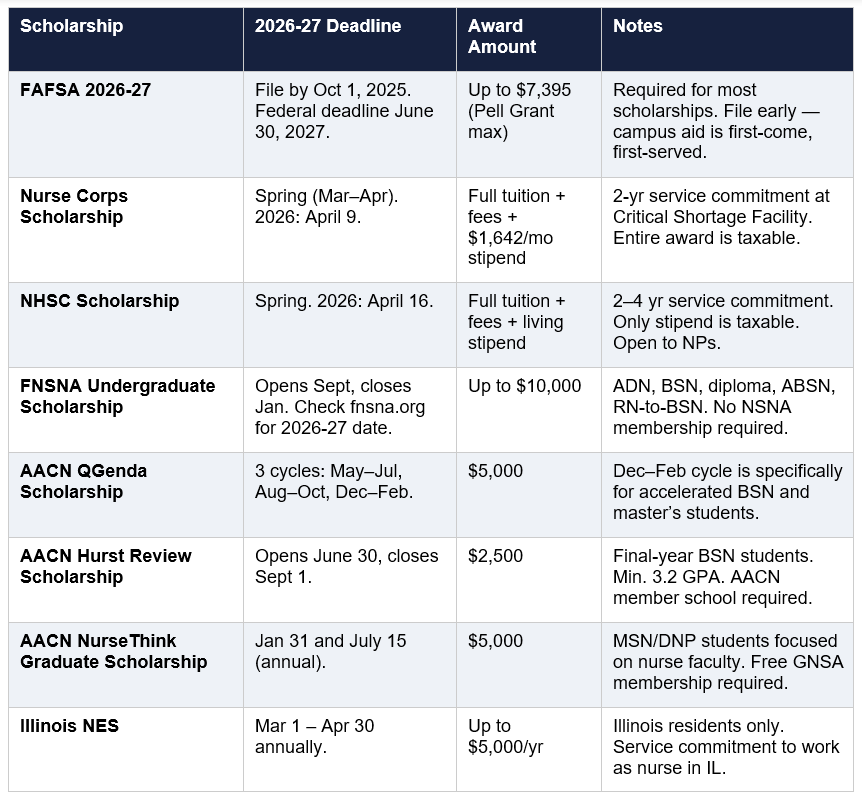
2026-2027 Scholarship Quick Reference
These are the programs covered in this guide with confirmed or expected deadlines:
Nursing school is expensive. But there’s more money available specifically for nursing students than for almost any other field because healthcare systems, federal agencies and professional organizations all have a direct interest in funding the next generation of nurses. That funding exists. You just have to apply for it.
Start with the FAFSA. Then work through this list, starting with the programs that fit your situation best. Put the deadlines in your calendar now. And if you’re still working toward admission studying for the TEAS while figuring out all of this Testavia has TEAS 7 practice questions, visual study guides for anatomy, and progress tracking built for pre-nursing students. Try it free for 7 days.
Frequently Asked Questions
Yes, for most of them. Even private scholarships and hospital-based awards often require a completed FAFSA to verify financial need. Skipping it disqualifies you from far more funding than just federal loans and grants. File as early as October for the best shot at campus-based aid, which runs out fast.
A BSN typically costs $40,000 to $100,000, depending on whether you attend a public in-state school, a private university, or an accelerated program. ADN programs at community colleges are much cheaper often under $15,000 total. MSN and DNP programs usually run $35,000 to $80,000+.
The Nurse Corps Scholarship Program from HRSA. It covers full tuition, fees, books, clinical supplies, and pays a monthly stipend of $1,642 for 2026-27. In exchange, you commit to at least two years of work at a Critical Shortage Facility after graduation.
Yes. Not all scholarships are merit-based. Many federal and need-based programs like the Nurse Corps Scholarship and Pell Grant prioritize financial need over GPA. Hospital tuition reimbursement programs also don’t always require high grades. Focus on need-based and service-commitment scholarships if your GPA is below 3.0.
It depends. Scholarships used for tuition, required fees, and books are usually tax-free. But money used for living expenses, housing, or stipends is taxable. The Nurse Corps Scholarship is fully taxable including tuition. The NHSC Scholarship only taxes the stipend portion. Budget for this when you plan your finances.
As many as you qualify for. Students who get fully funded typically apply to 30-50+ scholarships over the course of their program. Small awards ($500–$2,500) stack up fast and are often less competitive than the big ones everyone applies for.
The 2026-27 FAFSA opened on September 24, 2025. The federal deadline is June 30, 2027, but you should file as early as October 2025 to maximize campus-based aid, which is awarded first-come, first-served.
Most federal programs like Nurse Corps, NHSC, and Pell Grants require U.S. citizenship or permanent residency. But some private scholarships, hospital tuition assistance programs, and university-specific awards are open to international students. Check with your school’s financial aid office and look into hospital employer-sponsored programs.
Many do. Large health systems like HCA, Ascension, CommonSpirit, and Banner Health offer tuition reimbursement or full scholarships in exchange for a 1–2 year work commitment after graduation. If you’re already working as a CNA, PCT, or in any healthcare role, ask HR about education benefits — you may qualify immediately.
Scholarships are usually merit-based (GPA, essays, achievements), while grants are need-based (financial situation). Both are gift aid that you don’t have to repay. The Pell Grant is the biggest federal grant for nursing students; scholarships like FNSNA and AACN awards are merit-and-need hybrids.