
To study for the HESI A2, give yourself 6 weeks at 8 to 12 hours a week. Start with a full-length diagnostic. Spend 60% of your time on your school’s required sections (usually Math, Reading, Vocab, Grammar, plus A&P), 30% on your weakest of those sections, and the final 10% on full-length timed practice in the last two weeks. Use the official Elsevier Admission Assessment Exam Review as your backbone, add one practice platform, and aim for 80%+ on every section before test day. If you want a structured version of that plan with adaptive practice questions, our team at Testavia built one specifically for HESI A2 applicants.
The HESI A2 isn’t a knowledge test. It’s a section-weighting test. Win the four sections your school weights heaviest, and the rest takes care of itself. That single shift in thinking separates the people who pass from the people who retake.
Before You Build a Plan: Three Things to Know
Most people start studying before they know what they’re studying for. That’s the first mistake.
First, confirm which sections your school requires. The HESI A2 is modular — Elsevier offers 8 academic subtests, but most nursing programs require only 4 to 6. If your school doesn’t test Physics, every hour you spend on it is wasted. Email the program coordinator. Check the admissions page. Get it in writing.
Second, know your target score. ADN programs typically want 75% to 80% composite. Competitive BSN programs want 85%+. And here’s the trap: many require 80% on A&P specifically. A 78% composite can still fail you if your A&P sits at 76%. Plan section by section, not in aggregate.
Third, pick your timeline. Four weeks if you’ve recently completed A&P and chemistry coursework. Six weeks if you’re like most applicants. Eight weeks if science is rough or English isn’t your first language. Pick honestly.
If you’re retaking the HESI, skip the diagnostic step. Your last score report is your diagnostic. Throw 70%+ of your time at the two lowest sections and don’t look back.
What’s Actually on the HESI A2
The full HESI A2 runs 8 academic sections plus 2 unscored personal sections (Learning Style and Personality Profile). Your version depends on what your school selected. Here’s the standard breakdown:
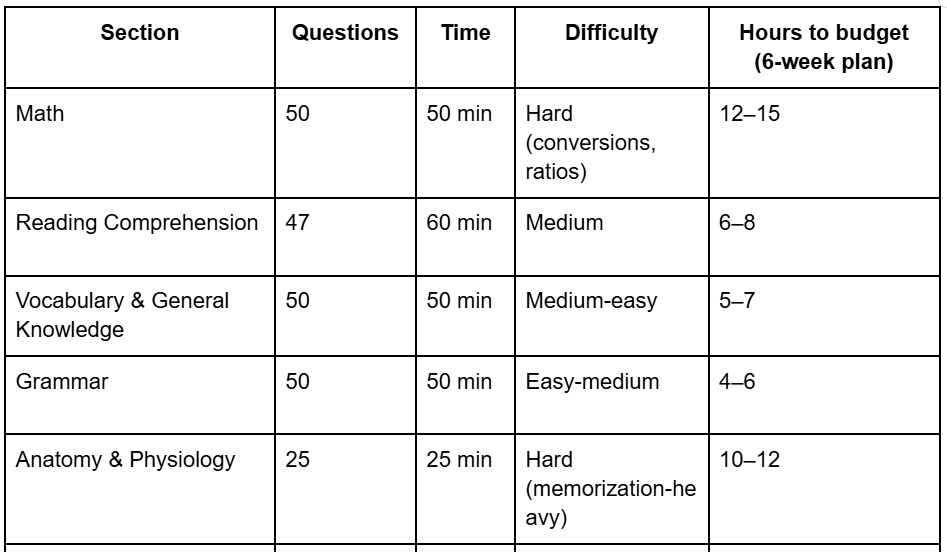
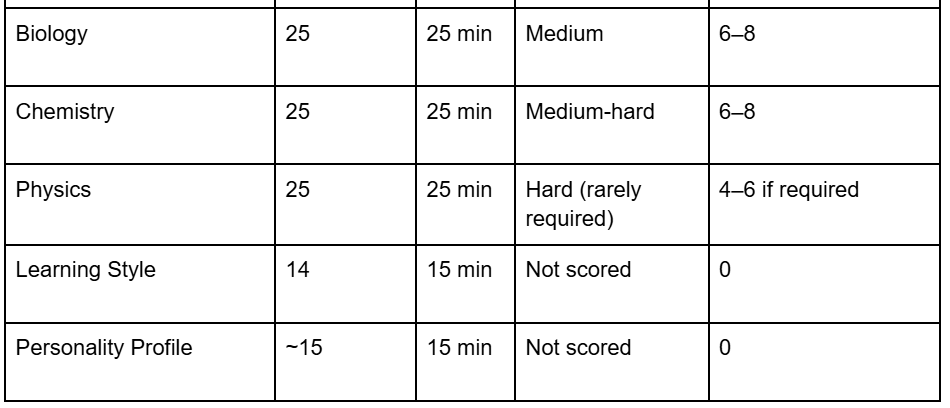
One detail nobody tells you: 5 questions per section are experimental and don’t count toward your score. You can’t tell which ones, so answer them all like they do. Don’t waste a single brain cell trying to guess.
Math and A&P eat the most hours for a reason. They’re the sections where most applicants lose points, and they’re the sections most schools weight the heaviest. Plan accordingly.
The 6-Week HESI A2 Study Plan (Recommended)
Six weeks at 10 hours a week. That’s the sweet spot. Here’s how to spend it.
Week 1 — Diagnostic and Map
Take a full-length diagnostic on day one. Time it. No phone. No interruptions. Then compare every section score to your school’s cutoff and rank your sections from weakest to strongest. That ranking is your study plan in miniature.
Days 3 through 7, read the Elsevier book’s intro chapters and the first chapter of your two weakest sections. About 8 hours total. The point isn’t to learn everything. It’s to figure out what you don’t know.
Weeks 2 and 3 — Drill Your Two Weakest Sections
This is where the gains live. Spend 60% of your weekly time on your weakest section. Another 25% on your second-weakest. And 15% on maintenance review of your strong sections, because you don’t want to win Math and lose Vocab.
End of week 3, take a section-level practice test on your weakest section. Goal: land within 5 points of your target.
Week 4 — Drill Sections 3 and 4 (Plus Vocab and Grammar Mop-Up)
Vocabulary is a cheat code. About 90% of the words come straight from the Elsevier book’s word list. Skip the random outside vocab apps. Spend 15 minutes a day on Anki or paper flashcards using only Elsevier’s list. Done.
Grammar gets one focused 90-minute session on the rules you missed in your diagnostic. Most missed rules: subject-verb agreement, pronoun case, parallel structure.
Then drop 6 to 8 hours on whichever science section you haven’t drilled yet.
Week 5 — Full-Length Practice and Pacing
Mid-week, take one full-length timed practice test. Review every wrong answer. Don’t move on to the next question until you understand why the correct answer is correct. Knowing you got it wrong doesn’t teach you anything. Understanding why does.
Week 6 — Final Polish and Test Day
Take one more full-length practice on a different platform than your first one. Different question pools catch different gaps. Light review of cheat-sheet topics, unit conversions, common prefixes and suffixes, A&P diagrams. Three days before the exam, stop with new material entirely. Sleep. Hydrate. Light review only.
Total time: roughly 60 to 72 hours over 6 weeks. That’s the number.
Don’t Have 6 Weeks? The 4-Week Crash Plan
The 4-week plan works if you’ve taken Bio, A&P or Chem within the last two years, or you’re a strong test-taker with recent academic momentum. Otherwise, you’ll burn out and underperform.
Compress to 12 to 15 hours a week. Skip maintenance on strong sections — you’ll lose 2 to 3 points there and that’s fine. Pick one resource platform and stay with it. Take one full-length timed test in week 3 instead of two.
If you’re retaking and have 4 weeks, this plan works on one condition: focus 70%+ of your time on your two lowest sections from your last score report. Everything else is a distraction.
Have More Time? The 8-Week First-Try Pass Plan
The 8-week plan is built for applicants weak in science, returning to school after several years, or studying in a second language. It’s also better if you can’t reliably hit 10+ hours a week.
Aim for 6 to 8 hours a week, sustainable, with less burnout. Add a week 0 pre-study where you relearn fractions, decimals, and percentages from Khan Academy before touching any HESI material.
Take two diagnostics — one at week 1, one at week 5. If you’re not seeing 10+ point improvement on your weakest section by week 5, your study method is broken. Change something.
The Resource Stack
Most applicants buy too many resources. Here’s what to actually use.
Tier 1 — buy this first. The official Elsevier Admission Assessment Exam Review book, 6th edition. About $45 to $60. It’s the closest content match to the actual exam. If you only buy one thing, buy this. The Chamberlain University prep guide and basically every nursing forum thread agree.
Tier 2 — add one practice platform. Just one. Testavia’s adaptive HESI A2 prep, Mometrix, or NurseHub. The trap most people fall into is bouncing between 4 platforms, getting 30% through each, and never finishing anything.
Tier 3 — free supplements. Khan Academy for math and chemistry fundamentals. Quizlet decks for vocab (but verify them against the Elsevier book community decks have errors).
Skip these. Pre-2023 YouTube playlists. Generic “nursing entrance” books that aren’t HESI-specific. Random TikTok study hacks.
Section-by-Section Tactics
Math. Memorize unit conversions cold. Metric to standard. Celsius to Fahrenheit. Drill ratio and proportion problems every single day, they dominate the section. The calculator is on-screen, so practice with that, not your phone.
Reading Comprehension. Read the questions first, then the passage. You’ll read more efficiently because you know what to look for. Practice with non-fiction prose — NIH abstracts, news articles, anything that mimics the test’s tone.
Vocabulary. 90% of the words come straight from the Elsevier book. Don’t waste time on outside word lists. Drill the Elsevier list until you know every word cold.
Grammar. Subject-verb agreement, pronoun case, parallel structure. Those three rules cover most of the points students lose.
A&P. Body systems beat obscure anatomy. Cardiovascular flow, the nephron, hormones, basic neurology, these topics show up over and over. The Nurse.org HESI exam guide confirms what every test-taker thread says: A&P is the highest-stakes science section.
Biology. Cell structure. Photosynthesis vs respiration. Genetics (Punnett squares). Basic taxonomy. Stay surface-level on everything else.
Chemistry. Periodic table trends. Basic stoichiometry. Acids and bases. Dilutions.
Physics (if required). Newton’s laws, basic kinematics, optics, electricity basics. Surface-level coverage wins points. Don’t try to master physics in 6 weeks if it’s just one of 5 required sections.
If English is your second language, allocate roughly 1.5x time to Reading and Vocabulary. Pair every new word with a sentence in context, not just a definition.
Test Day Tactics (And Three Things That Tank Scores)
What works on test day. Eat protein 60 to 90 minutes before. Skip sugary energy drinks, the crash hits mid-exam. Bring approved ID and payment confirmation. No phone in the room. Use the full time allotted. Flagging questions and revisiting them is allowed and often smart. Don’t second-guess answers you were confident on. First-instinct accuracy is highest.
What tanks scores. Skipping the diagnostic, because then you spent 60 hours studying the wrong sections. Bouncing between 5 resources instead of committing to one book and one practice platform. Skipping timed practice. Pacing kills more scores than knowledge gaps by a lot.
Are You Ready? The Honest Test
If you can score your target percentage on a full-length practice test within the timed window twice in a row — you’re ready.
If you can’t, don’t reschedule on hope. Push the test back 2 to 4 weeks and finish the job. The retake fee plus the wait time costs more than another two weeks of prep.
Frequently Asked Questions
Most test-takers need 6 weeks at 8 to 12 hours a week. If you’re weak in science or English isn’t your first language, give yourself 8 weeks. Four weeks is possible if you’ve recently completed A&P and chemistry coursework, but it’s tight with no margin for life getting in the way.
Diagnose in week 1. Then spend 60% of remaining time on your two weakest sections. Skip new resources — pick one book (the Elsevier Admission Assessment Exam Review) and one practice platform. Take one full-length timed test in week 3, review every wrong answer, then polish in the final week.
The full HESI A2 has up to 326 questions across 8 academic sections plus 2 unscored personal sections. Most schools require only 4 to 6 sections, so your actual test will likely be 175 to 250 questions. Five per section are experimental and don’t count.
Three things. Know your school’s cutoff and target 5 points above it. Take at least two full-length timed practice tests and hit your target on both. Drill your weakest section harder than your strongest. Most first-try fails come from underestimating Math or A&P.
It’s not knowledge-impossible. The content is high school to early college academic material. But it’s harder than test-takers expect because of section-by-section cutoffs. A 78% composite can still fail you if A&P is under your school’s 80% floor.
The HESI A2 is a pre-admission academic test. The HESI Exit Exam is taken near graduation and tests NCLEX-style clinical reasoning. Different tests. Different content. Studying for one doesn’t prep you for the other. This guide covers the A2 only.
Yes, up to a point. Combine Khan Academy, Union Test Prep, and Quizlet decks with free trials from Mometrix and NurseHub. You’ll likely cap out around 70 to 75%. To clear 80%+ on every section, you’ll usually need the official Elsevier book or a structured course.
The Bottom Line
Plan for 6 weeks at 8 to 12 hours a week. Diagnose first. Then spend 60% on your weakest sections, 30% on second-weakest, and 10% on full-length timed practice. One official book — Elsevier plus one practice platform. Goal: 80%+ on every section across two consecutive full-length practice tests.
That’s the strategy. Want a free diagnostic that tells you exactly which sections to drill? Start your free trial of Testavia’s HESI A2 prep course and run the assessment in your first session.
Also worth reading: our complete HESI A2 prep guide and our breakdown of free HESI A2 practice tests.
