
To pass the TEAS test, you hit your target program’s cutoff usually 65% to 80% for BSN programs and 55% to 65% for ADN. That’s the whole game. The TEAS 7 gives you 170 questions across 209 minutes split into Reading, Math, Science, and English. You win by pacing each section at roughly 1:13 per question, front-loading anatomy and physiology, using the on-screen four-function calculator wisely, and answering every single question because skips count as wrong. If you want an adaptive platform that builds your study plan around your weakest section, our team at Testavia put one together specifically for TEAS applicants and retakers.
Most people who fail the TEAS didn’t fail because they didn’t know the material. Instead, they failed because they didn’t manage the clock. Or they left blanks. Or they over-studied A&P and got blindsided by scientific reasoning. Honestly, the exam isn’t really an academic test. Rather, it’s a section-allocation test with academic content underneath. So once you see it that way, your prep gets a lot more efficient.
Here’s the playbook.
What “Passing” the TEAS Actually Means
First things first: there is no universal pass mark. ATI doesn’t fail you. Your nursing program does.
Your official ATI score report shows three numbers: Total Composite Score (your overall percentage), Adjusted Individual Scores (per-section percentages, equated for form difficulty), and your National and Program Percentile Rank.
Meanwhile, ATI groups TEAS 7 scores into five proficiency tiers:
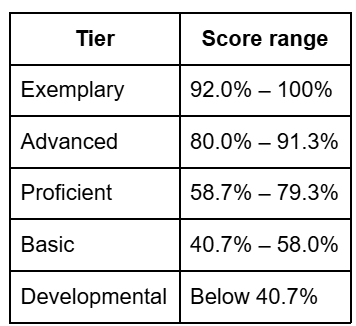
The tiers don’t decide your fate. What matters is whether your composite beats your target program’s cutoff. Forget the tier label. Look up your school’s number. Aim to beat it.
Find Your Real Target Score Before You Study Another Hour
Honestly, this is the step nearly everyone skips. And it’s the most important one.
First, email your program coordinator or pull up the admissions page. Then get their minimum TEAS composite in writing. Also, check if there’s a separate per-section minimum — some programs require 70%+ in Science specifically.
Next, build in a buffer. If the cutoff is 70%, aim for 78%+. After all, most nursing programs admit by rank, not threshold. Hitting the minimum doesn’t get you in. However, beating the minimum by 7 or 8 points does.
Common cutoffs to ballpark against:
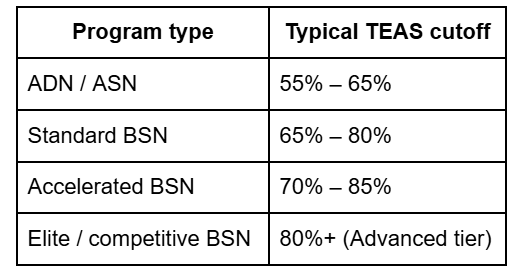
These are ranges, not promises. Confirm yours.
However, if you’re retaking and you scored 58% last time and need 65%, that’s a 7-point gap. About 11 more correct items across the whole exam. So that’s not a heroic comeback. That’s targetable. Therefore, lock onto your two lowest sections from your last score report and throw 75% of your study time there.
How to Pass the TEAS Test by Mastering the Pacing Map
Honestly, most TEAS fails are pacing fails. Not knowledge fails.
So here’s the per-section breakdown straight from ATI:
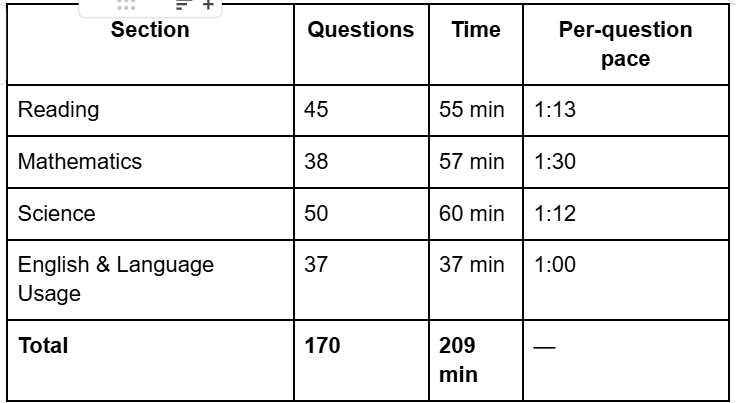
Here’s the rule. If a question is taking more than twice your per-question budget, flag it and move on. Come back if time allows. After all, drowning on one item costs you three you would’ve gotten right.
Meanwhile, English is the fastest section by design. So build a guess-and-go reflex for any item that doesn’t resolve in 60 seconds. Importantly, there is no penalty for guessing on the TEAS skipped questions count as wrong, so always submit an answer before time runs out.
Honestly, that last sentence is worth reading twice. People still walk into the TEAS thinking blanks are neutral. However, they aren’t. A blank is a guaranteed loss. Meanwhile, a guess is a 25% chance.
Section-by-Section Strategy
Different sections, different traps. Here’s what actually moves the needle.
Reading (aim ~75%)
Three question categories: main idea, details, source analysis. However, the trap is reading every passage front to back like you’re studying it. Don’t.
Instead, skim the passage first. Then read the question. Then go back into the passage and locate the answer. Honestly, reading for the question beats reading for comprehension every time on a timed exam.
Also, target the easy 35 questions first. Then flag the inference-heavy items and loop back. After all, Reading rewards triage.
Mathematics (aim ~70%)
Hot topics: PEMDAS, fraction-to-decimal-to-percent conversions, one-variable algebra, geometry basics (area, volume, perimeter), word problems, and ratios.
However, here’s the calculator catch. The on-screen calculator is plus, minus, times, divide. Period. No square root. No parentheses. No memory. So if a problem needs (3 + 4) × 5, you’re doing the parentheses in your head. Therefore, master mental math for these gaps before test day or you’ll lose easy points to silly mistakes.
Also, 1:30 per question is generous. Use it. Re-read the question stem before you answer — after all, math word problems hide the actual question in the last sentence half the time.
Science (aim ~67% — the hardest section)
Here’s the math behind why Science is the make-or-break section. 18 of the 50 questions are anatomy and physiology. So that’s the biggest single content lever in the entire TEAS. Then biology (9), chemistry (8), and scientific reasoning (9).
Therefore, if you only have 6 weeks and weak science, spend half of every science study session on A&P. Body systems, cardiovascular flow, the nephron, hormones, basic neurology. After all, these topics show up over and over.
Also, ATI has been emphasizing balancing chemical equations, mitosis and meiosis, and microorganisms more in recent forms, per Nurse.org’s TEAS guide. So don’t sleep on those even though they’re a smaller portion of the section.
English & Language Usage (aim ~70%)
37 questions in 37 minutes. So this is the fastest pace on the exam. No room to re-read.
Therefore, drill these specifically: pronoun-antecedent agreement, subject-verb agreement, comma rules, prefixes and suffixes, and medical-term roots. After all, those five topics cover most of the section.
Also, if English is your second language, the pacing here punishes hesitation more than anything else. So build a 300-word TEAS vocabulary list and drill it daily. Pair every new word with a sentence in context, not just a definition. Honestly, context is what makes vocab stick under time pressure.
Test-Day Tactics That Add Points Without More Studying
What you do on test day can swing your score 3 to 5 points. Maybe more if you’re a panicker.
The Night Before
No new content. Instead, skim your formula sheet. Set two alarms. Go to bed early. Honestly, anyone who tells you to cram the night before has never passed the TEAS.
The Morning Of
Eat a protein-forward breakfast. Eggs and oatmeal, not a granola bar. Water but not too much. Also, bring your ID and admission docs. Then arrive 30 minutes early.
During the Exam
The second the section starts, dump your formulas onto scrap paper. Quadratic formula. Common conversions. Whatever you’ve been holding in your head — get it on paper before stress evicts it.
Next, use the flag function. Mark anything that needs more than twice your pace budget and move on. Most sections give you enough time to revisit 3 to 5 flagged items if you’ve stayed on pace.
Also, run a two-pass strategy on Reading and Math. Answer everything you know first. Then loop back for the harder ones. This protects your point total when time gets tight.
Meanwhile, remember that the on-screen calculator only appears on calculator-eligible items. So don’t waste seconds hunting for it on every Math question.
Above all, answer every single question. Even pure guesses. Skips equal wrong.
Finally, take the optional break after Math. Three minutes of slow breathing is worth more than three minutes of extra Science review.
If You’re Retaking the TEAS
First, pull your previous score report and stare at the Adjusted Individual Scores. After all, those tell you exactly where you bled points last time.
Next, allocate your study hours proportional to your gaps. For example, if your last attempt was Science 55, Math 70, Reading 75, English 80, your split should look like 50% Science, 25% Math, 15% English, 10% Reading maintenance. So don’t study evenly. Also, don’t study what you’re already strong at. Instead, hit the wound.
Now, about retake timing. You can retest after 14 days at an ATI Testing Center. However, plan on about 30 days when administered through your school. Also, many nursing programs cap retakes at 3 per application cycle, so check yours before you book.
Above all, a retake isn’t a do-over. Rather, it’s a targeted strike on the two sections that tanked your last score. So treat it that way and your odds jump.
Five Reasons Smart Test-Takers Still Fail
Here’s what the post-mortems look like, over and over.
First, they studied content but ignored pacing. Knew the material. Ran out of time on Science. Walked out at 56%.
Next, plenty of students skip questions. As a result, they leave blanks expecting some kind of no-penalty mercy that doesn’t exist on the TEAS.
Another common failure point: over-studying A&P and under-studying scientific reasoning. Sure, A&P is 18 questions. However, the other 32 in Science still count.
Many also trust free random practice questions that aren’t aligned to TEAS 7 question types. The real exam uses multi-select, hot spot, ordered response, and fill-in-the-blank items. So if your practice is all four-option multiple choice, you’re prepping for the wrong test.
Finally, some never take a diagnostic. Therefore, they study evenly instead of triaging. Even study time on uneven gaps equals mediocre results across the board.
The Honest Path
So three things work, in this order.
First, a diagnostic that maps your actual weak spots, broken out by section and topic. Second, a study plan that allocates time proportional to those gaps, not evenly. Finally, weekly timed full-length practice tests that train both knowledge and pacing.
Honestly, that’s the system. It’s not glamorous, but it compounds.
So start your free trial of Testavia’s adaptive TEAS prep course and the diagnostic builds your plan automatically based on your weakest objectives. Or grab free TEAS practice tests to see where you stand right now. Also, if you want the day-by-day calendar version of all this, see our 4-, 8-, and 12-week TEAS study plan.
Frequently Asked Questions
Honestly, there’s no single passing score every nursing program sets its own. ADN programs typically require 55% to 65%, BSN programs 65% to 80%, and competitive programs 80%+ (the Advanced tier). So aim 7 to 10 points above the cutoff because most schools admit by rank, not threshold.
Honestly, the TEAS is set at high-school-graduate academic level hard without preparation, very passable with it. However, the 209-minute length and Science section trip up the unprepared. Still, most students who study consistently for 6 to 8 weeks and take timed practice tests reach the Proficient tier (58.7%+).
ATI doesn’t publish a hard lifetime cap. However, their retake policy requires 14 days between attempts at an ATI Testing Center and typically 30 days for institution-administered exams. Also, most nursing programs limit you to 2 to 3 attempts per application cycle.
Technically, you can’t fail the TEAS in the ATI sense — you’ll always get a score. However, you can score below your target program’s minimum, which means your application gets denied or pushed to the next cycle. So that’s why passing the TEAS is program-specific, not test-specific.
Yes. Skipped questions count as wrong. Also, there’s no penalty for guessing, so always submit an answer. Meanwhile, use the flag function to mark uncertain items and return to them if time allows. Above all, never leave the test with blanks.
Science. 50 questions with 18 from anatomy and physiology, plus biology, chemistry, and scientific reasoning. Meanwhile, Math is second-hardest because the on-screen calculator is four-function only no square roots, no parentheses so you’ll do conversions and PEMDAS mentally.
Yes, an on-screen four-function calculator (plus, minus, times, divide) appears on calculator-eligible items in Math and Science. However, no square root key, no parentheses, no memory. Also, you cannot bring your own. So master mental math for conversions, fractions, and basic exponents before test day.
Most students need 4 to 8 weeks at 1 to 2 hours per day. However, if your diagnostic is more than 15 points below your target, plan 8 to 12 weeks. Honestly, the biggest predictor of passing isn’t total hours rather, it’s whether you took at least 2 to 3 full-length timed practice tests before exam day.
The Bottom Line
So find your target. Pace each section. Front-load A&P. Above all, answer every single question. Also, use the on-screen calculator like it’s free points, because it is.
Ultimately, whether you pass or fail is decided more by how you allocate the 209 minutes than by how many hours you logged the week before. So pick your number. Then build the plan. And run the practice tests under time. Do that and the rest takes care of itself.
Finally, start your free trial of Testavia’s TEAS prep course and the diagnostic builds the retake or first-try plan around your weakest sections automatically.
