Waiting for NCLEX results feels unbearable. You leave the testing center replaying every question, second-guessing answers, wondering if you passed. And that’s when two options start circulating in every nursing student group chat: the NCLEX Quick Results and the Pearson VUE Trick (PVT).
Here’s the short answer:
- NCLEX Quick Results is an official paid service from Pearson VUE that releases your unofficial pass/fail result 48 hours after your exam for a fee of $7.95.
- The Pearson VUE Trick is an unofficial method where you attempt to re-register for the NCLEX. If you get a “good pop-up” blocking the payment, it usually means you passed.
One is official. The other is a rumor that’s been surprisingly accurate for years. But which should you actually trust? I’ve been there, I’ve used both, and I’ve talked to hundreds of nursing students who have too. Here’s what actually works from one nurse to another.
What Are NCLEX Quick Results?
This is because the NCLEX Quick Results are the official method to verify your NCLEX results before the exam and directly through Pearson VUE. This is a paid service that allows you to view your unofficial results in just 48 hours following your test.
Here’s how it is done:
- Take approximately the two days following your test.
- Log in to the account you have created with your Pearson VUE Account.
- Click “Quick Results.”
- You will have to pay $7.95 to view your results immediately.
They are not official. However, in almost every instance, they’re in line with your official score provided by the state’s nursing board. It’s quick, precise, and endorsed through Pearson along with the NCSBN (National Council of State Boards of Nursing).
Shortly, the NCLEX Quick Results are legitimate as they are accurate and reliable.
What Is the Pearson VUE Trick?
The Pearson VUE trick (PVT) is something entirely different. It’s not officially licensed it’s just a hack that nursing students have discovered to guess their NCLEX test results prior to the 48-hour timeframe.
Here’s how:
After your test, you log back to the account you created in your Pearson VUE account and attempt to register to take the NCLEX. Based on the message that comes up, you will be able to guess whether you were successful or not.
- If you receive “good popup” “good popup”:
- “Our records show that you recently scheduled this test. There is no possibility of registering again at the moment.”
- That typically means you were successful.
- If you receive “bad” or “bad popups”:
- “Your payment has been accepted” or “Credit card declined.”
- It typically means that you weren’t able to make it through.
The trick was quickly propagated via forums for nurses and TikTok, but there’s a truth to it: although it’s possible to be accurate, it’s not always 100% accurate.
NCLEX Quick Results vs. Pearson VUE Trick — The Real Difference
Let’s compare the two side by side:
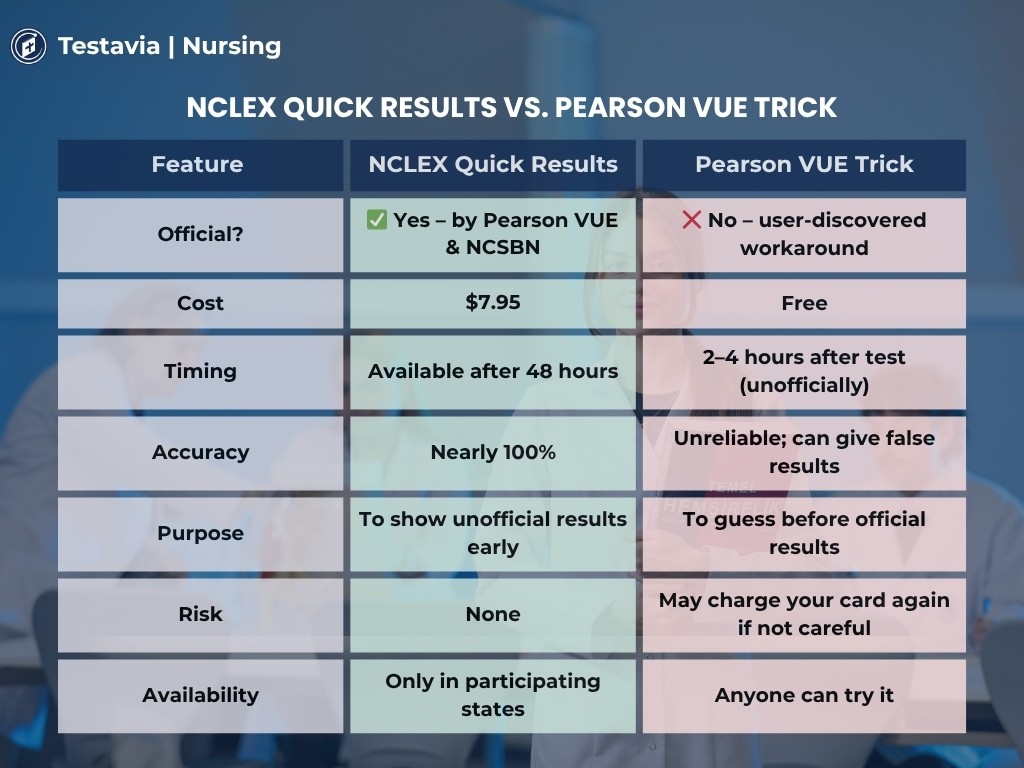
Table 1: NCLEX Quick Results vs. Pearson VUE Trick
Therefore, even though it’s true that the Pearson VUE trick is appealing (especially when you’re struggling to rest from anxiety), Quick Results can be one of the sole methods that is officially accepted as valid by Pearson as well as NCSBN.
If you truly want peace of mind and you don’t want to put your trust in the risk of a false hope, take the time to wait for two weeks and then go through this official Quick Results page.
Why So Many Students Still Try the Trick
Honestly? It’s all the nerves. The waiting game following the NCLEX is exhausting. It’s all too familiar, scrolling through Reddit and looking for “Does the Pearson Vue Trick still work in 2025?” Looking for a clue.
Sure, students require something to keep. When they get the “good popup,” it can provide a bit of relief even if it’s not 100% guaranteed.
However, I’ve also seen students get the right popup, but fail. I’ve also seen students get the incorrect one and then get a pass. Take it for what you will: a rumor-based stress alleviation and not a proven method.
My Honest Advice
If you’re in a hurry to find out, I completely understand. Here’s what I’d suggest:
- Use the Pearson VUE Trick only when you are aware that it is not official.
- Don’t place your entire heart (or your credit card) on the credit card.
- If you have waited 48 hours, use NCLEX Quick Results to find the actual answer.
- Celebrate and plan your next steps with a clear head.
Keep in mind: Failing the NCLEX once does not mean you are a failure. Many incredible nurses have been precisely where you are. It’s all that matters is persistence — not the popup that you viewed online.
Conclusion (NCLEX Quick Results)
The distinction in quick results from the NCLEX, as well as the Pearson VUE trick, boils down to confidence.
- Rapid Results = precise, paid, and authentic.
- Pearson VUE trick = emotional, free, and unreliable.
If your job is on the line, pick the one that offers facts and not only feelings. If you’re sitting there now, hang in there. You’ve already accomplished something amazing when you passed that test.
While waiting, use the time to review your foundations or check out time management strategies for nursing students so you’re ready for whatever comes next. If you’ve failed or failed this time around, the journey to becoming a nurse is just getting started.
Frequently Asked Questions
The Pearson VUE Trick (PVT) still works for many students, but it’s never been officially confirmed and accuracy varies. Students have passed despite getting a “bad pop-up” and failed despite getting a “good pop-up.” Treat it as a stress-management tool, not a verified result.
NCLEX Quick Results match official board results in nearly every case. The unofficial pass/fail status released after 48 hours is generated from the same scoring system used for official licensure decisions — so the result you see is functionally what your state board will report.
The PVT requires you to start the actual NCLEX re-registration process meaning if the system accepts your payment, you’ve been charged for a second exam attempt. That’s why a “credit card declined” or “payment accepted” pop-up is considered a fail signal. Most students dispute the charge afterward, but it’s not guaranteed.
No. NCLEX Quick Results is the fastest official option, and it’s only available 48 hours after your exam. Official board results take anywhere from 2 to 6 weeks depending on your state. Anything claiming to deliver results sooner is unofficial.
Yes — the trick has been reported to work for both NCLEX-RN and NCLEX-PN candidates, since both exams use the Pearson VUE registration system. Accuracy is similar (and similarly unreliable) across both.
The good pop-up reads: “Our records indicate that you have recently scheduled this exam. Another registration cannot be made at this time.” If you see this without being asked for payment, it suggests your results have been processed and you likely passed.
If you absolutely need an indication and can’t wait 48 hours for Quick Results, the PVT can offer some peace of mind. But don’t make any major life decisions accepting a job, moving for a position or telling family based on the trick alone. Always wait for Quick Results or the official board notification.
First, don’t panic. The trick isn’t 100% accurate, and students have passed despite getting bad pop-ups. Wait the full 48 hours for Quick Results to confirm, and if you do fail, remember that most states allow you to retake the NCLEX after a 45-day waiting period. Use the time to identify weak areas and prepare differently.
Get started today with 1 month free access to our NCLEX study resources today.