
You’re sitting there staring at your nursing program application, and the ATI TEAS exam requirement feels like a wall between you and your future. Everyone’s telling you different things; some say it’s easy, others act like it’s impossibly hard.
The truth? The ATI TEAS exam is challenging, but your success depends more on how you prepare than how naturally smart you are. If you’re stressed, overwhelmed, or returning to academics after years away, that’s normal.
This guide breaks down exactly what makes the TEAS difficult, what you’re actually being tested on, and how to prepare without burning out.
The current version is TEAS 7 and understanding what it tests and why students struggle is your first step toward walking into that testing center with confidence instead of panic.
What Is the ATI TEAS Exam? (TEAS 7 Overview)
The ATI TEAS (Test of Essential Academic Skills) measures your academic readiness for nursing and allied health programs. Schools use your TEAS score to predict whether you can handle the academic rigor of their programs. Most nursing schools require it as part of admissions, and your score can make or break your application when spots are competitive.
TEAS 7 launched in 2022 and replaced TEAS 6. The update reflects current nursing education standards and adjusted question types to better assess critical thinking. According to ATI Testing, the exam evaluates four core areas: Reading, Mathematics, Science and English & Language Usage. These aren’t trick questions designed to confuse you they test whether you have the foundational skills to succeed in nursing school.
The exam measures academic readiness, so you’ll see content you learned (or should have learned) in high school and early college. That’s part of what makes it difficult, you’re being tested on years of accumulated knowledge often under time pressure, and sometimes after being out of school for a while.
What Makes the ATI TEAS Exam Difficult for Many Students?
The breadth of content is overwhelming. You’re tested on reading comprehension, math, anatomy and physiology, biology, chemistry, scientific reasoning, grammar and more all in one sitting. That’s a lot of ground to cover, and students often don’t know where to focus first.
Time pressure amplifies stress. Each section has a time limit, and you can’t go back once you finish. If you run out of time, those unanswered questions hurt your score. Students who don’t practice under timed conditions often panic when they realize they’re only halfway through with five minutes left.
Many test-takers are returning to academics after years away. Maybe you graduated high school a decade ago, or you’ve been working full-time and haven’t touched algebra since 2015. Relearning foundational concepts while juggling work and life makes preparation harder.
The stakes are high. You’re not taking the TEAS for fun—you need a competitive score to get into nursing school. That pressure creates anxiety and anxiety makes even manageable questions feel impossible. Fear of failure becomes its own obstacle.
Breakdown of TEAS 7 Sections (With Difficulty Level)
TEAS 7 has four sections. Each one tests different skills and each one trips up students in different ways.
Reading (39 questions • 55 minutes)
The Reading section tests your ability to understand passages, interpret charts, identify key ideas, and make inferences. You’ll read short texts and answer questions about main ideas, author intent, supporting details, and logical conclusions.
Why students struggle: Speed and inference. You have about 1.4 minutes per question, which includes reading time. If you’re a slow reader or second-guess yourself, you’ll run out of time. Inference questions ask you to “read between the lines,” which feels subjective when you’re stressed.
What helps: Practice reading actively. Underline key points as you go. Answer what the passage says, not what you think it should say.
Mathematics (38 questions • 57 minutes)
The Math section covers arithmetic (fractions, decimals, percentages), algebra (solving equations, ratios), measurement (conversions, metric system), and data interpretation (graphs, charts).
Why students struggle: Many adult learners haven’t used algebra in years. Fractions and decimals trip people up. Measurement conversions require memorization. You’re also expected to solve problems without a calculator for some questions.
What helps: Review basic operations first. Practice converting between fractions, decimals, and percentages until it’s automatic. Memorize common conversions (pounds to kilograms, inches to centimeters).
Science (50 questions • 60 minutes)
The Science section is the heaviest and most difficult for most students. It covers Human Anatomy & Physiology (~18 questions), Biology (~9 questions), Chemistry (~8 questions), and Scientific Reasoning (~9 questions).
Anatomy and physiology dominate. You’ll answer questions about body systems: cardiovascular, respiratory, nervous, endocrine, digestive, immune, musculoskeletal and renal.
Biology covers cells, genetics, macromolecules and microbiology.
Chemistry tests atomic structure, chemical reactions, acids and bases and states of matter. Scientific reasoning evaluates your ability to interpret data, understand experiments, and apply the scientific method.
Why students struggle: The volume is brutal. You’re expected to know foundational content across four scientific disciplines in one hour. Questions often combine content knowledge with reasoning skills, so you have to apply what you know.
If you need a deeper breakdown of what’s tested in the Science section, check out TEAS 7 Science Questions: What to Expect & How to Actually Prepare.
What helps: Study anatomy and physiology first—it’s your biggest focus. Use diagrams and flowcharts for visual learning. Practice interpreting graphs and data sets for scientific reasoning.
English and Language Usage (37 questions • 37 minutes)
This section tests grammar, sentence structure, punctuation, capitalization, and spelling. You’ll identify errors, choose correct forms, and demonstrate knowledge of standard written English. This section tests grammar, sentence structure, punctuation, capitalization, and spelling. You’ll identify errors, choose correct forms, and demonstrate knowledge of standard written English. For a deeper breakdown of what’s actually tested here, see our guide on ATI TEAS English questions and how to master them.
Why students struggle: Small mistakes cost easy points. You might know the content but second-guess yourself on comma rules or subject-verb agreement. The section feels straightforward, so students under-prepare, then miss points on careless errors.
Why students struggle: Small mistakes cost easy points. You might know the content but second-guess yourself on comma rules or subject-verb agreement. The section feels straightforward, so students under-prepare, then miss points on careless errors.
What helps: Review grammar rules systematically. Practice identifying errors in sentences. Take your time this section allows exactly one minute per question, so use it.
TEAS 7 Format, Timing, and Scoring
The TEAS 7 has 170 total questions across four sections. Of those, 150 are scored and 20 are unscored pretest items (used by ATI to test future questions). You won’t know which questions are pretest, so treat every question like it counts.
Here’s the breakdown:
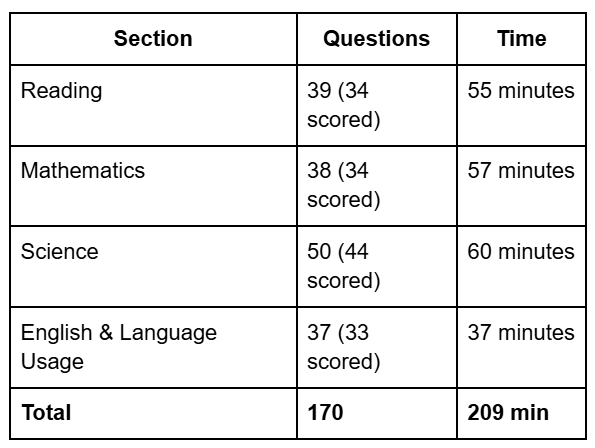
Your score is reported as a composite percentage (0-100%) and individual section percentages. According to the National League for Nursing, most nursing programs look for composite scores between 60-75%, but competitive programs often want 75% or higher.
Pacing matters more than perfection. You don’t need to ace every question. You need to answer enough correctly within the time limit. Spending five minutes on one hard question means skipping three easier ones at the end.
Is the ATI TEAS Harder Than Other Nursing Entrance Exams?
Students often ask how the TEAS compares to the HESI A2, another common nursing entrance exam. Both tests cover similar content—math, science, reading and English but the TEAS tends to feel harder for students weak in science because of its heavy anatomy and physiology focus.
The HESI A2 includes additional sections like vocabulary and learning style assessments, but its science section is less dense than the TEAS. If you’re strong in biology and anatomy, the TEAS plays to your strengths. If you’re not, it exposes those gaps quickly.
For context on how the TEAS compares to the NCLEX (the licensing exam you’ll take after nursing school), read TEAS vs NCLEX: Which Nursing Exam is Harder?. Spoiler: the TEAS tests foundational knowledge while the NCLEX tests clinical judgment.
Schools use TEAS scores heavily in admissions decisions. A strong TEAS score can offset a lower GPA, and a weak TEAS score can knock you out of consideration even if your GPA is solid. That’s why preparation matters.
How to Prepare for the ATI TEAS Exam the Right Way
Start With a Diagnostic Test
Take a full-length practice test before you start studying. This shows you where you’re weak and where you’re already strong. Don’t waste time reviewing math if you’re already scoring 90% on math practice questions focus on your actual weak areas.
ATI’s official practice tests mirror the real exam format. Use them to establish a baseline.
Study With Structure, Not Overwhelm
Don’t try to study everything at once. Break your prep into sections. Dedicate specific days to specific topics, Monday for cardiovascular system, Tuesday for fractions and decimals, Wednesday for grammar rules. Spaced repetition works better than cramming.
Use visual aids for science topics. Draw the heart and label the chambers, create flowcharts for mitosis and meiosis. Your brain retains visual information better than text-heavy notes.
Practice Under Real Test Conditions
Take timed practice tests regularly. Simulate the real testing environment—no phone, no breaks mid-section, strict time limits. This builds endurance and reduces test-day anxiety.
The more you practice under pressure, the calmer you’ll feel when the real test starts.
For a comprehensive study approach, check out ATI TEAS Study Guide and TEAS and NCLEX Preparation.
Common Mistakes That Make the TEAS Feel Harder Than It Is
- Studying without a plan. Random studying leads to random results. You need a structured schedule that covers all sections systematically.
- Ignoring weak subjects. Avoiding chemistry because you hate it means leaving easy points on the table. Face your weak areas early.
- Memorizing instead of understanding. The TEAS tests application, not recall. You need to understand why the heart pumps blood the way it does, not just memorize valve names.
- Not practicing under timed conditions. Untimed practice feels easy. Timed practice reveals where you actually struggle.
How Testavia Helps Students Pass TEAS 7 (Without Burnout)
Testavia was built specifically for overwhelmed nursing students who need clarity. Our TEAS 7 prep includes practice questions aligned with the current exam, simplified study notes, visual guides for complex topics and progress tracking so you know exactly where you stand.
We prepare you for nursing school survival beyond entrance exams. Try it free for 7 days. No credit card required. Just real help when you need it most.
Final Verdict: Is the ATI TEAS Exam Difficult?
Yes, the ATI TEAS is challenging. It covers a lot of ground, tests you under time pressure and carries high stakes for your nursing school application.
But it’s also manageable. Thousands of students pass the TEAS every year, and they’re not smarter than you they just prepared strategically. Success depends on your preparation strategy not luck or natural ability.
Frequently Asked Questions
It’s challenging, but most students who prepare strategically pass on their first try. The TEAS tests foundational knowledge in reading, math, science, and English under time pressure. Difficulty depends on your background — if you’ve recently studied anatomy or algebra, it’ll feel easier. If you’ve been out of school for years, it’ll require more prep.
There’s no universal passing score. Each nursing program sets its own minimum, usually between 60% and 75%. Competitive BSN programs often require 75% or higher. Always check your specific school’s requirements before testing.
Most students need 6 to 12 weeks of consistent prep, studying 1–2 hours per day. If you’re stronger in some sections (like English) and weaker in others (like Science), focus more time on your weak areas. Cramming in 2 weeks rarely works for the TEAS.
Science is the hardest section for most students. It covers anatomy and physiology, biology, chemistry, and scientific reasoning — all in 60 minutes. Anatomy and physiology alone make up about 18 questions, so it’s the section that requires the most dedicated study time.
Yes. Most programs let you take the TEAS up to 3 times per year, with a 30-day waiting period between attempts. Check your specific nursing school’s policy — some only consider your highest score, others average all attempts.
TEAS 7 is structured differently but not necessarily harder. It includes new question types like multiple-select, supply answer, and ordered response questions, which test critical thinking more than memorization. Students who prepare with TEAS 7-specific materials adapt quickly.
Yes. ATI offers a remote proctored TEAS through their website. You’ll need a quiet room, a webcam, and a stable internet connection. Some nursing programs only accept in-person testing scores, so check your school’s policy first.
If you’re anxious, that’s normal. Use that nervous energy to fuel focused, consistent study. You’ve got this. Start your free TEAS 7 prep with Testavia and prepare smarter not harder. Get full access to practice questions, study guides and the support you need to walk into test day confident. Start your free trial here.
I like how you broke down the exam into the four core sections—it really highlights that difficulty is relative depending on someone’s strengths. I’ve noticed that many students underestimate the Reading section, but those questions about interpreting charts and graphs can trip people up just as much as Science or Math. Building a prep plan that balances all areas instead of focusing only on the ‘hardest’ section seems like the smarter approach.